Out of the box learning with Dr Chelsea Hyde
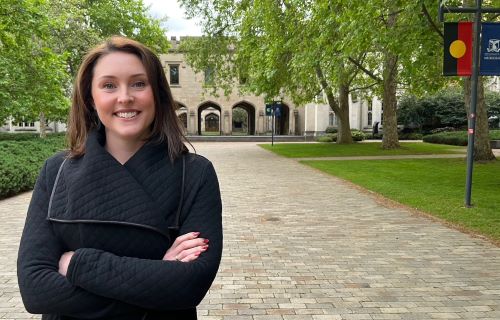
Meet Dr Chelsea Hyde, a Senior Lecturer in Educational Psychology in the Faculty of Education who recently won a University of Melbourne 2024 Staff Excellence Award for Place Based Initiatives.
Chelsea’s career so far
After working as a school psychologist in Victoria and Queensland, Chelsea reconnected with an academic mentor and took on sessional teaching work which quickly grew to a full-time role. In 2022 she became the course coordinator for the Master of Psychology (Educational & Developmental) program, while maintaining some private practice to maintain her practitioner skills.
While at the University of Melbourne, Chelsea has thrown herself into different initiatives, like the pilot Leading Educational Quality and Innovation (LEQI) program run by the Centre for the Study of Higher Education (CSHE). The program brought together mid-career academic staff from across the university who aspire to become educational leaders, with workshops and mentoring sessions with senior leaders and the chance to attend an academic board meeting. LEQI enabled Chelsea to connect with like-minded peers from across the University and facilitated collaboration that resulted in a successful Learning and Teaching Initiatives grant. She’s also recently been recognised as an Advance HE Senior Fellow, after completing the supported fellowship program funded by the University.
Innovative teaching
As a teacher Chelsea incorporates real-world learning opportunities into the classroom as often as possible. In one subject she tasked students with working in groups to develop a wellbeing consultation for a hypothetical school. The students did so well in this that she started to partner with the Faculty of Education’s placement schools to develop wellbeing consultation plans for the school to bring the students learning into a real-world situation, benefiting the students and partner schools alike.
Chelsea isn’t afraid to try some more out of the box activities in her teaching. After reading about creating virtual escape rooms in an online teaching forum during COVID she built her own activity around this during online learning in 2020 and 2021.
"I wanted to increase student engagement and promote wellbeing during synchronous zoom lessons and create opportunities for students to collaborate authentically."
Her students also value her practitioner perspectives and the relevant and authentic case studies she can provide, drawn from her practical work, to help them understand current issues within the field.
Receiving the 2024 Excellence Award for Place Based Initiatives
A key achievement for Chelsea, and one of the key reasons she was recognised with the 2024 Excellence Award for Place Based Initiatives and a Faculty of Education Excellence Award, is her work since 2016 in establishing the Regional Assessment Clinic. The Clinic helps connect the University of Melbourne to communities in the Goulburn Valley and Campaspe regions with a unique work-integrated learning experience for Master of Psychology (Educational & Developmental) students.
“I was so excited and honoured to receive this award in 2024. This project was a passion and labour of love, to receive this award that recognised eight years of work was very special.”
The Regional Assessment Clinic provides early identification and diagnosis of neurodevelopmental conditions enabling children to better access school-based supports and funding, addressing the dire lack of services in regional Victoria. Since 2016, the clinic has delivered over 150 low-cost assessments to the community and provided regional training opportunities for 75 masters students, and led to positive learning outcomes for students and high parent satisfaction.
What advice would she give an early career teacher who wants to be a teaching focused academic?
Chelsea says that the Graduate Certificate in Teaching (CGUT) or the Melbourne Teaching Certificate are great programs for education focused academics.
“When I began teaching, a lot of my practice was intuitive and lacked pedagogical structure. Participating in these programs gave me the frameworks I needed to build and redesign subjects which significantly improved my teaching.”
At a more informal level she says being part of communities of practice and SoTL groups focused on teaching practice is helpful to learn from education focused academics, along with taking opportunities to participate in programs offered by the University like GCUT, LEQI and mentoring. Learning Environments resources and workshops have also been invaluable to her, as well as her goal to upskill in a new digital resource each year like H5P, Feedback Fruits and SparkAI to name a few.
Chelsea encourages early career academics to take advantage of as many opportunities as possible to build out networks within their faculty and also outside of it.
"'Academia can sometimes be isolating but it doesn’t have to be. I am fortunate to have mentors and colleagues from different faculties who have helped shape my academic career and have shared opportunities that allowed me to create my academic identity. I try to pay this forward wherever I can."