People and Community Conversations: How can we disagree?
On Thursday 23 October the second in a series of People and Community conversations was held, focusing on the topic ‘how can we disagree?’
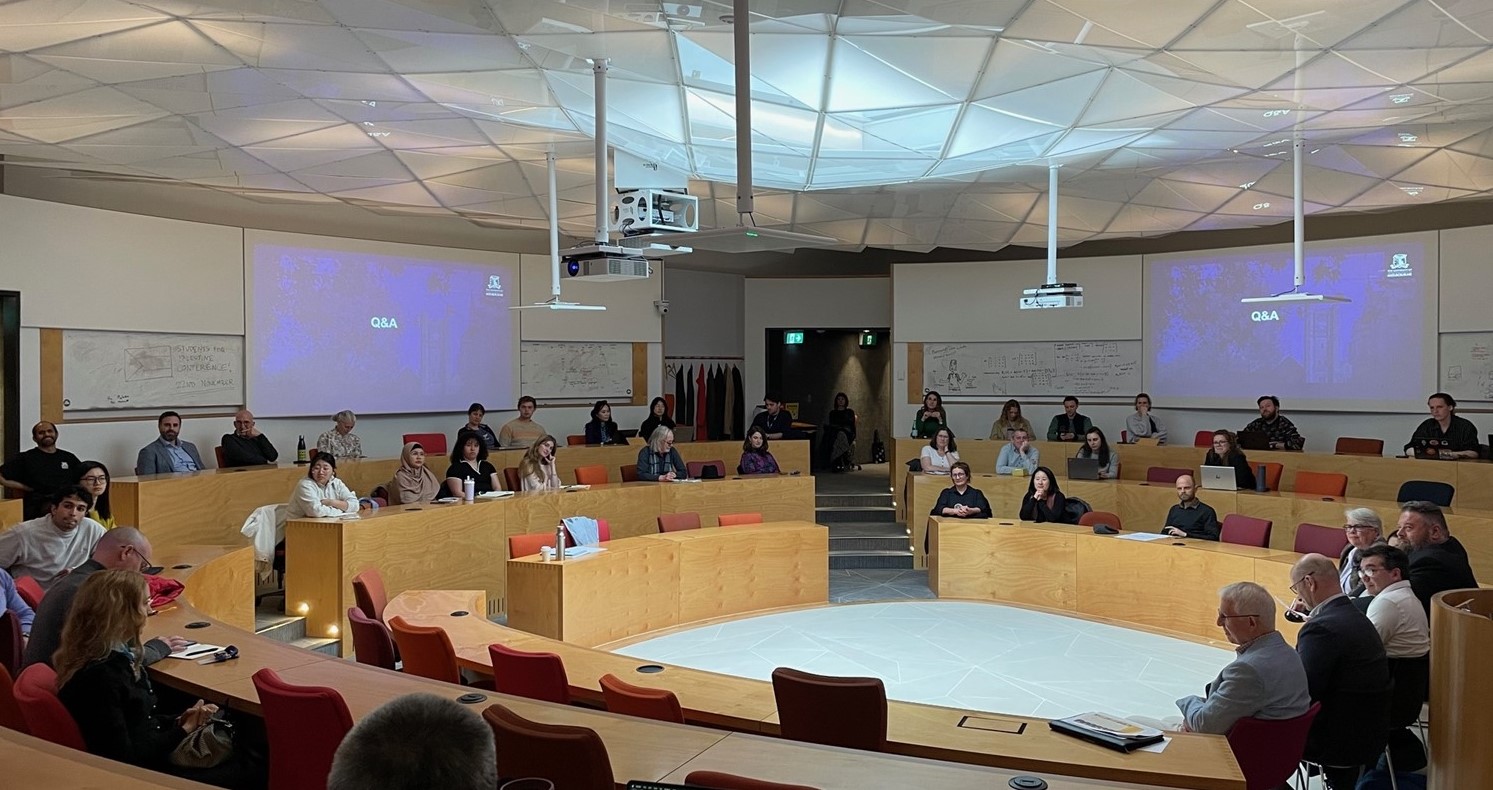
Approximately 45 staff and students participated in the discussion which considered questions such as do people feel it's ok to disagree with one another; does disagreement feel like a dangerous thing to do; and what factors affect how easy it is for people to be able to express disagreement.
The discussion was co-hosted by Lesley Stirling, Acting Deputy Vice-Chancellor People and Community and Momoka Honda, President, University of Melbourne Student Union, International.
Lesley commenced the session with some opening remarks noting that we live in times of heightened conflict, polarisation and uncertainty. The expression of polarised views on social media is indicative of disagreement, yet in face-to-face settings such as in classes and meetings, it sometimes feels as if people are reluctant to openly take differing positions from one another.
Lesley asked the audience to consider, in such times, what might it mean to “disagree well”, to create opportunities for listening and sharing of perspectives that can be constructive? And what is the role of universities in promoting better opportunities to disagree?
Co-host Momoka Honda commented that living between cultures in her life experience so far (specifically Japan and Taiwan) has shown her how differently people express disagreement and how easily misunderstandings can happen when we don’t take the time to listen and understand where others are coming from.
Momoka touched on the fact that students come from all around the world, bringing diverse perspectives with them. For many students, university is one of the first places they are encouraged to question, challenge, and exchange ideas openly, and that can be both exciting and uncomfortable at times. Momoka observed that learning to disagree well is not just about expressing our own opinions, but also about creating space for others to be heard, even when their views differ from ours.
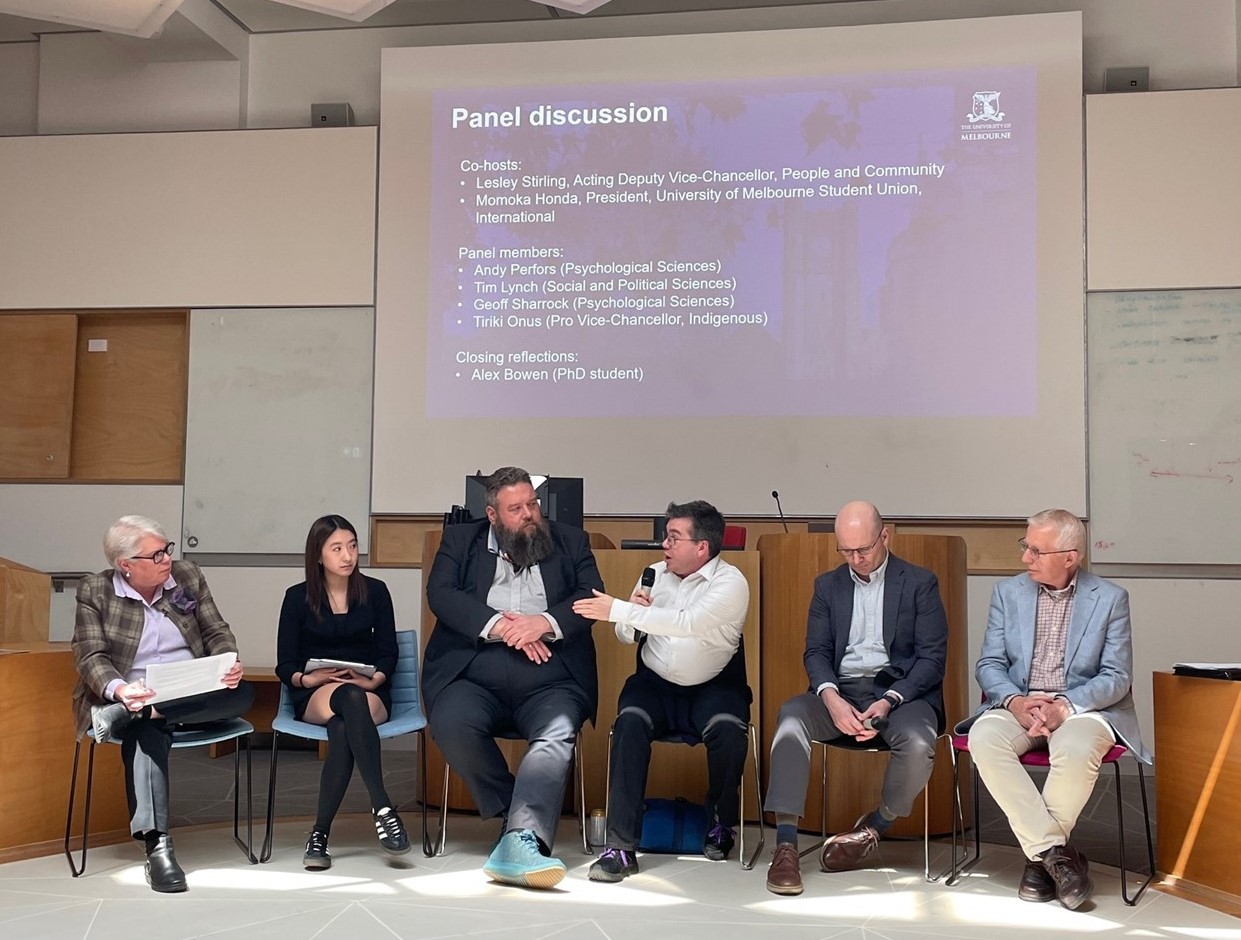
Panel discussion
The session moved into a panel discussion drawing on expertise from University community members including Professor Andy Perfors (Psychological Sciences), Professor Tim Lynch (Social and Political Sciences), Dr Geoff Sharrock (Psychological Sciences) and Tiriki Onus (Pro Vice-Chancellor, Indigenous).
To open the discussion, Tiriki responded to the question: do you think people feel it's okay to disagree with one another or does it feel like a dangerous thing to do? Tiriki felt it’s dependant on our own positionality and where we stand. Whether or not we feel safe to bring disagreement into a particular space can be a significant determinant of our experience of university and other spaces. We are all used to feeling discomfort in disagreement at times. A large part of a university experience is to disagree and be engaged in lively conversation.
Andy then made some observations around what factors affect how easy it is for people to be able to express disagreement, which led into discussion around what is the point of disagreement. Andy observed that humans are trying to collaboratively figure out the world together and learn from each other, so there is always going to be disagreement within this as we don’t all look at things in the same way and no one person knows everything.
The factors that make disagreement work are ensuring that we are all on the same common ground, with the same goal of trying to understand each other rather than some other aim such as performing for others, trying to score points or signal one’s affiliations. Linguistic and cultural barriers can make that even harder, but we need to work hard to make obstacles as neutral as possible.
Geoff then shared some insights around how in a teaching environment or university context, staff can set up the classroom or learning forum to make it comfortable for appropriate debate. This involves introducing some clear ground rules at the outset and Geoff shared the model he has developed through his work during the past few years – essentially a set of practices that are 'group learning habits' for a teaching and learning environment.
Tim then provided some remarks around creating safe spaces for disagreement and universities being places for disagreement, remarking that these days we are even arguing over whether we can have conservative opinions on campus.
A few times during the session, the discussion opened to Q&A/comments from the audience. Topics and comments included:
- Has the corporatisation of universities stimulated debate or stifled it?
- A discussion around how it can feel like lots of things are going wrong in the world today and as a result institutions are becoming risk-averse, and students are more risk-averse – all of which is a rational response to a perceived dangerous environment.
- The notion that disagreeing well includes trying to get people to feel more comfortable with being uncomfortable – and generally people aren't very comfortable with that!
- A discussion around the idea of how we hold space for others and ourselves to sit with discomfort, which is a challenge.
- The importance of knowing who we are before we can know someone else and if we wish to create spaces of safety, we must be invested in the safety and security of others.
- A question about whether feelings of contempt for a person with a different view can be unwound, as the expression of contempt works against productive forms of debate.
- And a comment that you can get a long way in life, regardless of your position on things, if you're a decent human being.
The final questions to the panel considered: what does good disagreement look like? And what can universities do to promote better practices of disagreement? Comments included:
- The institution is about knowledge and there will always be debate within this.
- We need to consider how we can make this real in the classroom.
- Debate should be open-minded and rigorous, but we need to seek to understand each other not seek to debate or to win or tally rhetorical points.
To close out the session, some reflective remarks were provided by Alex Bowen, a PhD student in linguistics, helping to draw the key themes together for all participants.
Alex commented that the discussion showed disagreement comes down largely to relationships – how we relate to each other, how we seek to understand each other and the world around us. The concept of ‘safety’ also came up a lot in the discussion. Safety has to do with knowing who we are and what we’re bringing to a situation. This includes vulnerability versus resilience, anxiety and risk aversion and on the other hand, rigour and debate.
Everyone in the discussion seemed to agree that we need to be able to disagree, but we need to set some ground rules for disagreement and listening and self-awareness are key skills.
Thank you to everyone involved for the open and respectful conversation. Further People and Community conversation sessions will be held in the new year.