People and Community Conversations: Trust
On Tuesday 23 September the first in a series of People and Community conversations was held, focusing on the topic of ‘trust’.
A group of staff and students participated in the discussion which considered questions such as ‘what makes it possible for us to trust?’, ‘how can we trust wisely?’, ‘how is trust earned?’, and ‘what is it to be trustworthy?’.
The discussion was hosted by Lesley Stirling, Acting Deputy Vice-Chancellor People and Community and Joshua Stagg, President, University of Melbourne Student Union.
Lesley commenced the session with some opening remarks around trust in universities being an increasingly relevant topic at the national level and observing that we live in times of heightened tension, conflict and uncertainty. This makes it difficult for us to trust each other as well as to trust institutions and governments.
Co-host Joshua Stagg touched on the lack of trust between communities and how the people in the room for the trust discussion cannot fix this at a national level but can try and set an example at our university. Joshua also commented there are issues where he and the university disagree, but disagreement does not have to mean disrespect.
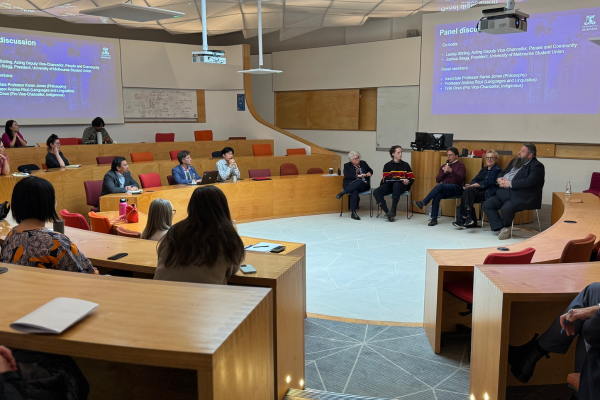
Panel discussion
The session moved into a panel discussion drawing on expertise from University community members who work on trust in their research including Associate Professor Karen Jones (Philosophy) and Professor Andrea Rizzi (Languages and Linguistics), and Tiriki Onus (Pro Vice-Chancellor, Indigenous).
To open the discussion, Tiriki provided some insights on the issue of trust in the context of First Nations perspectives. Tiriki touched on the fact that trust is deeply ingrained in relationships of accountability, and talked about the role of relational risk when dealing with new parties.
We need to understand how we fit within each other’s lives. When we speak, we usually speak from a single perspective, our own experience – and that is it. The core aspect of establishing trust is that to understand someone else’s cultural identity, we must first understand our own. Dhoombak Goobgoowana(a History of Indigenous Australia and the University of Melbourne) is a great example of starting the process of truth-telling by thinking deeply about our positions and histories and bravely confronting how others may evaluate these. We must recognise that it is not up to us to define whether a space is safe for others.
Associate Professor Jones then spoke on the concepts of trust and trustworthiness and the relationship on those two things, as well as what the University can do to be seen as trustworthy. Insights shared included that trustworthiness is the target of trust. Trust succeeds when directed toward the trustworthy. However, trust is not always 'a good' – in some contexts it can enable exploitation and abuse.
You’re trustworthy if you’re responsive to the ways in which others count on you. Trust and distrust are self-confirming. They are lenses through which we interpret the language and actions of others. The same actions can be interpreted entirely differently depending on the level of trust through which the actions are viewed – if you already trust someone, you are more likely to interpret their actions favourably.
Trust and trustworthiness are also domain-indexed. Friends who you wouldn’t trust to do your taxes or perform neurosurgery on you are trustworthy in other domains.
To gain trust, institutions don’t have to do everything, everywhere, all at once. They can identify core areas of dependency that matter to people – asking, who is counting on the University, in what ways, and how can the University improve its performance and communicate those changes?
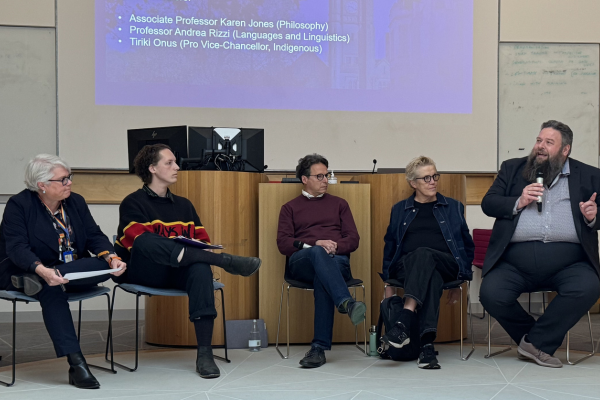
Professor Rizzi, who has worked on trustworthiness in the context of communication and community engagement, then provided some insights around personal and institutional trust and what the signs of trust and trustworthiness are.
Comments included that it is very hard to trust institutions. It requires a deep knowledge of how an institution works. But we have, as a University, a shared interest in education, in the wellbeing and the careers and lives of our students, and finding ways to communicate that shared interest can open better ways to understand what merits trustworthiness and how it might be communicated.
We need to ask ourselves: how do we understand each other’s trustworthiness? How do we communicate in a common language that allows us to share who we are and what we do? The communication is the most challenging element at times.
Joshua then shared some examples of issues which can impact trust which included increased restriction on peaceful assembly, privacy breaches and specific communities feeling unheard. He also touched on the lack of trust between some student groups at a student-to-student level. Joshua asked the panel for insights on how we move forward from here and rebuild trust. Comments from the panellists included:
- The role of emotions is a key component of decision-making. Some emotions are supportive of trust, driving out distrust, and vice versa. Fear and contempt drive out trust.
- There is real strength in the opportunity to engage in meaningful acts of storytelling – this is how we humanise and relate, creating coordinates of belonging to locate ourselves. We don’t have to agree, but coordinates of belonging that can be marked out provide an easier way for people to navigate towards understanding others better.
- We sometimes retreat to bureaucratic systems and responses when confronted with challenges. This doesn’t allow space in-between. Allowing vulnerability is hard work and creating a more thriving environment for spaces like the one we were situated in, to discuss trust, can support vulnerability and openness.
- How can the community we’re part of ensure there’s a sense of a safe space? We’re all part of a larger social space. We need to find ways to be more courageous and brave and enable safety in this institutional space we all comprise as individuals.
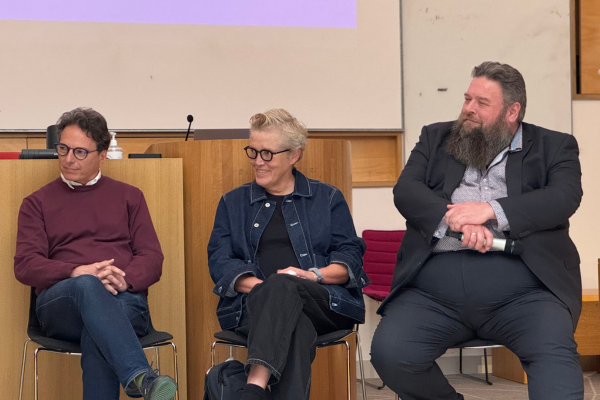
Open Q&A
The panel discussion was followed by an open Q&A session with the audience in the room. Questions covered topics including:
- Challenges around creating spaces of trust and safety – how do we create spaces safe enough to have bolder conversations around difficult topics?
- Discussion of what universities are, and what universities should do – including the role of universities, the concept of institutional neutrality and the question of whether or not institutions can and indeed should be neutral.
- Distrust is not necessarily a bad thing – for example, it can be self-protective to be cautious in giving trust.
- The University’s adoption of the IHRA definition of antisemitism, and what this means for the ability of people to trust the University as an institution.
- The distinction between freedom of speech and academic freedom.
- The role of leadership in creating environments where teams can thrive, free of fear, to share ideas.
- Developing roles for people management and ways to provide role models for students, peers, and other leadership scenarios. Creating teams where all people can participate.
To close out the session, some insightful reflective remarks were provided by PhD student Andrew Irvin, a Graduate Student Association representative from the Faculty of Arts, helping to draw the key themes together for all participants.
Thank you to everyone involved for their open and respectful conversation.
The next People and Community conversation will be held on Thursday 23 October at 12pm and will discuss the topic ‘how can we disagree’.