The University of Melbourne’s storied history spans more than 170 years, beginning with its establishment as Victoria’s first university in 1853. See how its campuses, community and curriculum have constantly evolved through archival images and detailed timelines.
Old Arts Building clock tower, UMA-ITE-2003000302523, University of Melbourne Archives.
Historical highlights
1853
The University of Melbourne is established, becoming the first in Victoria.
1883
Julia ‘Bella’ Guerin is awarded a Bachelor of Arts, becoming Australia’s first woman graduate.
1922
Melbourne University Press is established, Australia’s oldest university publisher.
1947
A short-lived campus was established in Mildura to accommodate the large numbers of students after World War II.
1972
South Lawn Carpark opens with its distinctive parabolic columns, creating a flat lawn on its roof.
2025
The late Emma Johnston was appointed Vice-Chancellor, the first woman to hold this position.
Archives and special collections
Established in 2026, the University of Melbourne Archives (UMA) is one of the largest non-government research archives in Australia, preserving the records of value to the University, its partners and the broader community.
University of Melbourne crest, UMA-ITE-2017007100792, University of Melbourne Archives.
Timeline of University milestones
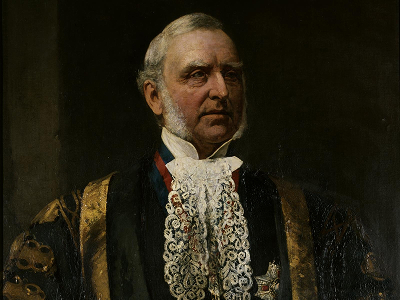
Redmond Barry, the University’s founding Chancellor.
George Folingsby, The Hon. Sir Redmond Barry KCMG, c.1874, The University of Melbourne Art Collection, Melbourne.
1853
The University of Melbourne is established by an act of Victorian Parliament.
1855
Teaching commences in the Bachelor of Arts, with subjects in classics, science, mathematics, history and modern languages.
1856
Australia’s first law school is established.
1862
Medicine is established, the first in Australia.
1863
An engineering school is founded.
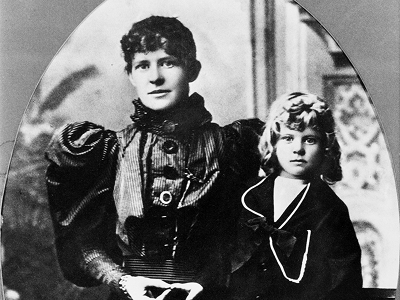
Bella Guerin with her son, Henry.
Halloran, Bella, nee Guerin, with her son Henry, UMA-ITE-2003000300364, University of Melbourne Archives.
1881
The University admits women students.
1883
Julia ‘Bella’ Guerin is awarded a Bachelor of Arts, becoming Australia’s first woman graduate.
1883
Wilson Hall opens.
1884
Melbourne University Union established.
1886
Bachelor of Science degree established.
1888
Princess Ida Club formed for women students, staff and alumni.
1891
Australia’s first women medical students graduate – Grace Clara Stone and Margaret Whyte.
1894
The Conservatorium of Music is established.
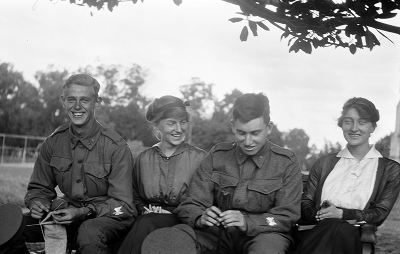
Students and soldiers. 1725 students served during the war, of whom 251 died.
McKellar, Doris, Friends of Doris McKellar at the University of Melbourne, c. 1917, UMA-ITE-1975004800051, University of Melbourne Archives.
1900
The University has conferred 3000 degrees. 16 per cent of graduates are women.
1901
The fraud of the University accountant is discovered, prompting a Royal Commission.
1903
Diploma of Education is pioneered by the University of Melbourne.
1905
Agricultural Science course established.
1906
Students’ Representative Council established.
1908
Veterinary Science established.
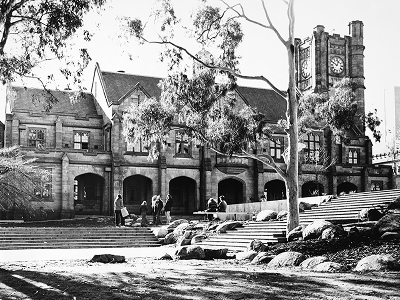
The Old Arts building.
Old Arts Building, UMA-ITE-2003000302497, University of Melbourne Archives.
1919
Architectural Atelier opens.
1922
Melbourne University Press is established, Australia’s oldest university publisher.
1925
Farrago is established as a student newspaper.
1925
Commerce is established with support from Melbourne’s business community.
1926
Sidney Myer donates £100,000 to the University.
1933
The Melbourne Symphony Orchestra is reestablished and affiliated with the Melbourne Conservatorium of Music.
1934
Raymond Priestley is appointed as the first full-time Vice-Chancellor.
1936
Georgina Sweet elected by graduates to the University Council, the first woman councillor.
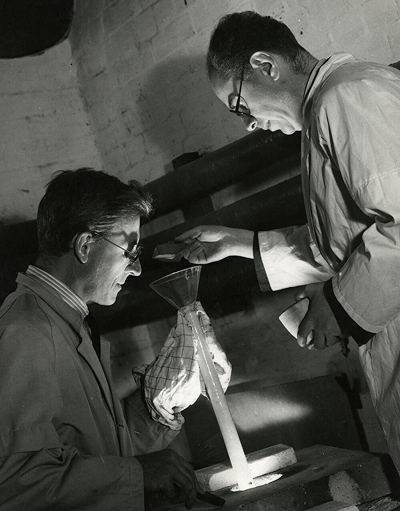
Optical Munitions: Melbourne service to Second World War.
Sach, Colin, Optical Munitions, University of Melbourne, c.1940-1942, UMA-ITE-2017007100487, University of Melbourne Archives.
1942
Diane Lemaire is Australia’s first woman engineering graduate.
1948
Australia’s first PhD graduate is Erica Wolff for her thesis on the French-Australian author Paul Wenz, the University having established the degree in 1946.
1947–49
The University establishes a campus in Mildura to accommodate the large numbers of students after the war.
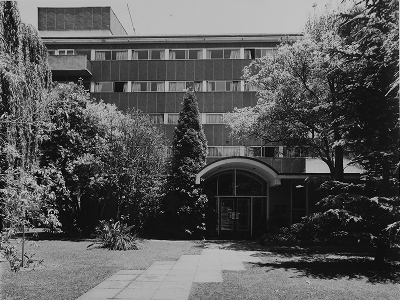
International House.
Wodetzki, Norman, International House, UMA-ITE-2003000302781, University of Melbourne Archives.
1953
The Union Theatre Repertory Company is established, premiering The Summer of the Seventeenth Doll by its director Ray Lawler. The Rep would become the Melbourne Theatre Company.
1956
Wilson Hall is reconstructed after being destroyed by fire in 1952.
1957
International House opens to support growing numbers of International students.
1959
Bundjalung woman Margaret Williams-Weir becomes the first Indigenous person to graduate from an Australian university.
1959
Baillieu Library opens.
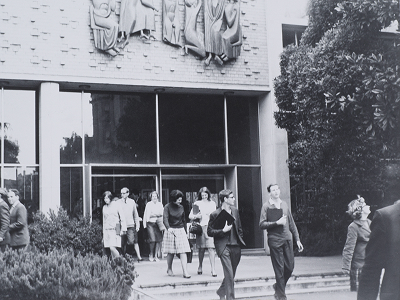
Students leaving Wilson Hall.
Wilson Hall, 1966, UMA-ITE-2003000302663, University of Melbourne Archives.
1969
The completion of the tri-radial medical building, with wings for pathology, anatomy and physiology, combined with the erection of the Microbiology building (1962) and Howard Florey laboratories (1963) creates a medical precinct adjacent to the Royal Melbourne and Royal Children’s hospitals.
1972
South Lawn Carpark opens with its distinctive parabolic columns, creating a flat lawn on its roof.
1973
The Melbourne Institute of Applied Economic and Social Research defines the Henderson Poverty Line, revealing a greater extent of community hardship than previously acknowledged.
1975
Priscilla Kincaid Smith appointed professor, the first woman to hold this position at the University.
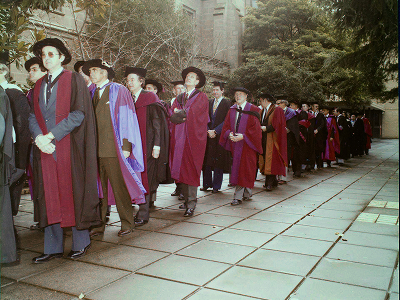
Academic procession into Wilson Hall during the Installation of Professor R. D. Wright as the University Chancellor.
Installation of the Chancellor, University of Melbourne, 1980, UMA-ITE-1981002600001, University of Melbourne Archives.
1983
The Cochlear Ear is developed by a team led by Graeme Clarke.
1989–1991
The Melbourne CAE, Victoria College of the Arts, Burnley College of Agriculture and Horticulture and Hawthorn Institute of Education amalgamate with the University.
1990
Australia’s connection to the internet is routed through the University of Melbourne.
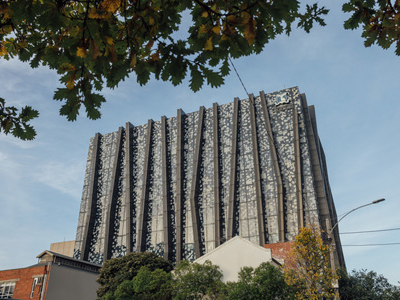
The prize-winning building The Spot opened in 2010, heralding a new commitment to sustainable design principles.
2008
The Melbourne Model is introduced, providing general undergraduate degrees followed by specialised post-graduate courses.
2010
The University launches the first of three Reconciliation Action Plans, aiming to “use the expertise and resources of its teaching and learning, research and knowledge transfer activities to make a sustained contribution to lifting the health, education and living standards of Aboriginal and Torres Strait Islander peoples”.
2016
The Atlantic Philanthropies grants the University $50 million to establish the Atlantic Fellows for Social Equity Indigenous leadership program.
2021
The Student Precinct opens.
2023
Narrm Scholarships established to support Indigenous and disadvantaged students to attend the University.
2024
Dhoombak Goobgoowana: A History of Indigenous Australia and the University of Melbourne, vol. 1: Truth is published to address the University’s long and difficult relationship with Indigenous peoples of Australia.
2025
Emma Johnston is appointed Vice-Chancellor, the first woman to hold this position.
Our notable alumni and staff
University alumni and staff together form a vibrant community of inspiring people from all walks of life. From prime ministers and Nobel Laureates to acclaimed actors and successful entrepreneurs, our community has achieved remarkable things and made a real difference in the world.