2025 Google PhD Fellowships awarded to University of Melbourne researchers
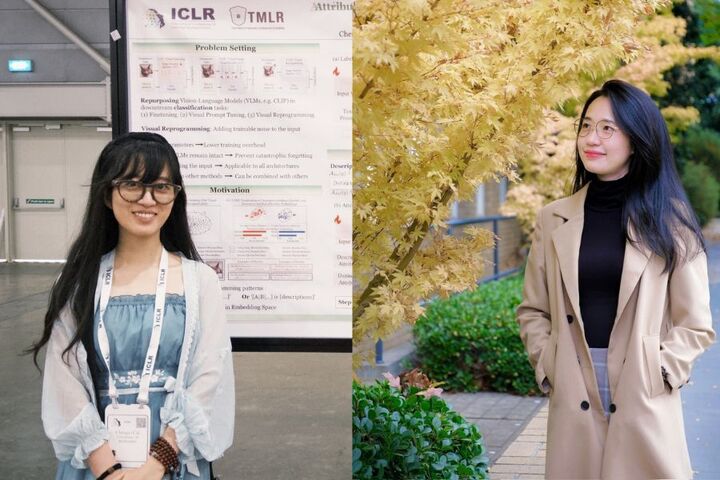
PhD students Thi Xuan May Le and Chengyi Cai have been awarded 2025 Google PhD Fellowships.
Both are studying in the School of Computing and Information Systems in the Faculty of Engineering and Information Technology, with Ms Le receiving the Fellowship in Health Research and Ms Cai in Machine Learning.
The Fellowships recognise outstanding graduate students who are conducting innovative research in computer science and related fields, specifically focusing on candidates who seek to influence the future of technology.
“I am honoured to receive this award,” Ms Le said. “The Google Research Fellowship is more than support, it’s a catalyst. It will empower me to turn ideas into impact and transform cutting-edge research into real-world solutions that enhance trustworthy, safe and effective clinical decision-making.”
Google notes the program provides vital direct financial support for the Fellows’ PhD pursuits and connects each Fellow with a dedicated Google Research Mentor.
Ms Le is researching trustworthy time series intelligence for healthcare applications. Her work is built on three pillars: interpretability, efficiency and robust performance.
By aligning methodological advancements with the practical demands of Health 4.0, including disease detection and prediction from time series data like electrocardiograms and vital signs, she aims to bridge the gap between state-of-the-art machine learning methods and their safe, effective integration into clinical practice.
Ms Cai’s research goal is to develop AI systems that are more adaptive and responsible – contributing both to the advancement of machine learning research and to real-world applications that benefit society at large.
“This fellowship is not only a recognition of the research work I’ve done, together with my supervisors and collaborators, but also an encouragement for my future studies,” she said.
“It gives me the opportunity to connect and collaborate with more scholars, and to further advance the development of more adaptive and responsible AI.”