In conversation session 1: How can we act for good?
As part of our ‘In conversation’ series, providing a forum for respectful dialogue on issues of interest for the University community, a discussion was held on Wednesday 12 August focused on: ‘How can we act for good?’.
Sponsored by the Interim Provost, these events bring together staff and students to consider the kind of University community we wish to create.
Co-hosted by Professor Lesley Stirling (Academic Lead, In Conversation series) and University of Melbourne Student Union (UMSU) President Lushy Chinganya, the event included facilitated discussions drawing on expertise from across the University community including from panellists:
- Professor Glyn Davis – Interim Vice-Chancellor, University of Melbourne
- Dr Tania Miletic – Co-Director, Initiative for Peacebuilding and Senior Research Fellow, School of Social and Political Sciences
- Professor Thas Nirmalathas – Dean, Engineering and Information Technology
A rich and detailed discussion considered such questions as: has acting for good always been part of the mission for universities?; how do we reconcile our aspirations to do good when considering the kinds of research we conduct; should universities take a neutral stance on societal questions which have diverse moral positions?; and how can we work with students to support their approach to actively understanding these positions and working towards a better society?
Lushy opened the discussion by posing a question to Glyn regarding how the ambition to ‘do good’ fits with the traditional idea of what a university is. Glyn reflected on the purpose of universities over time and offered that the notion that a university has to be part of the community and give something back has been a relatively recent perspective.
Lesley then raised the question of what counts as good and who gets to decide that. Tania discussed how in our many different roles, we can be thinking about the types of attitudinal, structural and cultural conditions at play and how we want to be “not contributing to the problem” in terms of people experiencing division, polarization or conflict.
Lushy asked Thas about the concept of universities taking a position of neutrality at an institutional level. Thas had many insights regarding the position universities take around the world (for example, the University of Chicago believing that universities should not comment on political and social issues) while reflecting that Australian universities tend to respond only to matters that affect the core mission of a university. Nevertheless, there are limits on what we sanction at the University as appropriate research or funding sources.
Lesley then asked the whole panel for their comments on whether we can bring our whole selves to work in terms of our beliefs, and perhaps our activism, and to what extent this is possible in today’s universities.
Comments included that there are expectations on professionals and we have to work in a way that’s respectful to others. And that we need to acknowledge that it’s not always an even playing field in terms of bringing your best professional self to work – not everyone is able to feel included all of the time.
Thas commented: “We want a place where people come to flourish. So that itself requires us to have certain guardrails for us to make that a welcoming place for many people, and the people to come here and actually use the university as a launchpad... even students, many of them, choose institutions because they see this is going to be a flourishing place. They can build themselves and go and be effective in society.”
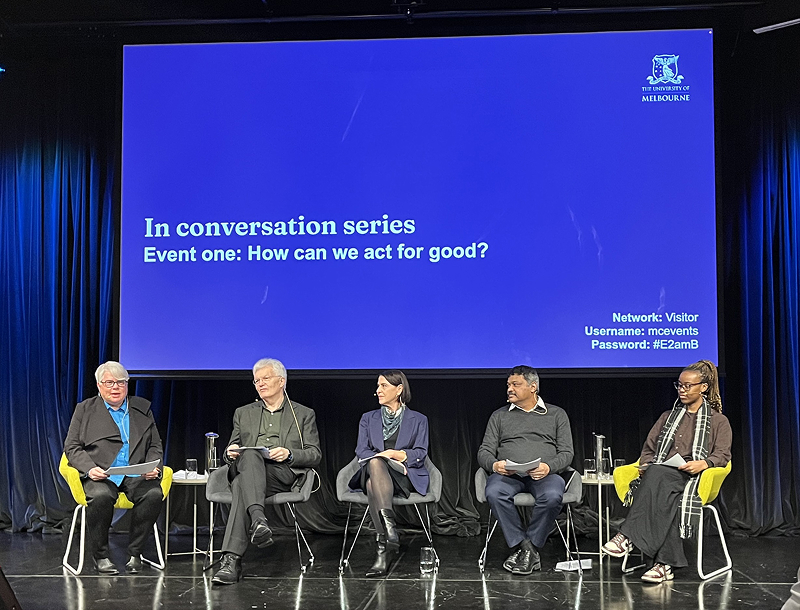
Image (L to R): Professor Lesley Stirling, Professor Glyn Davis, Dr Tania Miletic, Professor Thas Nirmalathas and UMSU President Lushy Chinganya at the ‘In conversation’ event.
Opening up to questions from the audience, the discussion moved to the question of how we can balance identity politics with a practice around a “relational bedrock” between members of our community, and how we can project that aspiration as an institution, not so much to our staff but to our students.
In response, Tania observed that in the university context, we need to try to create an environment that is conducive to people having the experience of sitting through an uncomfortable conversation. There are skills that we can cultivate at a university in terms of deep listening and critically engaging, opportunities you don’t often get elsewhere.
Lushy also commented: “I think one of my favourite things about my generation is that we're very vocal about issues that are going on in the world right now, and you're seeing that more and more. We're very much on the advocacy front. We would do a lot of campaigning, protests, all that sort of thing. And I think it's really important that recognizing that when we come to university, there's a lot of things that are going on.”
Lushy talked about creating space being important but noted that a lot of those spaces are already happening for students, together as a student body, and a good way for people to reach students is to meet them where they already are – to come and check out a little bit of their world, see what they get up to and what they talk about.
The next question asked if universities are committed to acting in the public good, why are they so criticized from all sides of politics almost constantly?
Glyn noted that it is really noticeable and it's a big change. And if you haven't been in the sector for a long time, you might think it was always this way, but that has not been the case. Glyn commented that it is hard not to be disconcerted when you read polls that say, in the United States now, the majority of Americans are hostile to higher education. And Glyn observed that: “…exactly the same shift has happened to pretty well every institution. It's very hard to find the institution that people don't say that about.” There is a profound legitimacy challenge we need to address. Thas commented that we need to recruit others such as our alumni to talk about us.
Next came a question around how this discussion could lead into how we consider the mission statements required of us by the federal government in the context of reforming universities and the public good they serve.
In response, Glyn talked about the Commonwealth’s aspirations for the university sector, which are always expressed in terms of the number of students who get to go to university, not in terms of the nature or quality of the education provided to them. We need a conversation about universities as a public good, rather than universities as transactional organisations capable of generating graduates for an economy that needs them.
The final question before returning to panel discussion considered academic freedom and where the university has and hasn't ventured into various areas with research, for example, human research ethics and animal research ethics protocols exist. The questioner asked about the University's relationship with fossil fuel companies.
Thas talked about the process within the university when we look at complex issues being: “…a proper due diligence, partially based on the evidence we have and also what's the impact to society and as a university we could make to that debate. And then basically see whether that can take place in the university or not.”
Glyn added: “Yes, we do have rules. We don't take money from a whole range of industries. And academic freedom is not an unrestricted right to do anything. There are things, areas we won't work in and areas we won't sanction research.”
Both Thas and Glyn also talked about the changing world and universities playing a role in transitions and responding to the way the world changes over time.
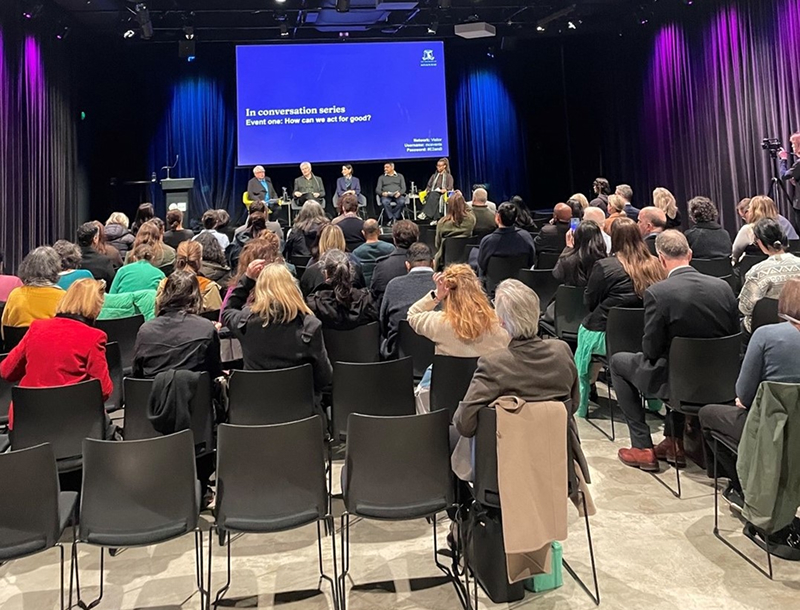
Image: audience listening into the panel discussion at Science Gallery, Melbourne Connect.
The conversation returned to panel discussion with Lesley asking: how we can hold space for other people in a context where it may seem impossible that we can really agree or that we can even compromise, can we sit uncomfortably with difference? Tania talked about creating listening opportunities and recognising the way many forums already exist that create these engagements.
Lushy then asked the panel about the students’ role in acting for good and how we can work together more effectively between staff and students. Glyn gave examples of fora and opportunities for people to meet and share ideas. He spoke about clubs and societies being a fabulous part of university life, alongside mentoring programs where later year students spend time with first year students.
Returning to questions from the audience, the panel was asked how the university can support students to enable the wonderful benefits being discussed. Thas reinforced Glyn's comments on clubs and societies providing a great forum for like-minded people to come together. And talked about the diverse set of programs the University offers as well as the continuous loop of how students engage with the university which can even be as alumni and re-investing in areas of interest.
A final question was posed around maintaining research excellence in mechanical engineering, particularly in defence or military applications, while also encouraging how student action can shape what the University supports in the future.
Glyn emphasised the importance of transparent decision-making processes, demonstrating that there has been engagement with the critique of particular research activities, and being clear about ethics controls and ‘no go’ areas. Transparency can give confidence that the institution is not engaged in things that would cause harm to people.
To close out the session, a reflective response and summary of the discussion was provided by PhD candidate in Conflict and Peace Studies, Sophia Htwe. Sophia reflected that the question of how we can act for good is not an easy one. Sophia observed we need to consider how we can create a community that brings different perspectives together, providing an opportunity to learn from one another. We don't need to reach agreement on every issue, but we do need to think about how we listen and how we can engage constructively and remain open to different perspectives.
Thank you to everyone who took the time to attend and we look forward to hosting future discussions – most immediately on Wednesday 16 September with a discussion focused on ‘how can we be brave, and feel safe?’. Register to attend.
These discussions lead on from two events held last year looking at trust and disagreement.