Campus Living Lab Guidance
This page provides guidance about how to set up a Campus Living Lab, as well as key information about the Campus Living Lab Accelerator program.
What is a Campus Living Lab?
The definition of a Campus Living Lab for this program is:
An activity where an attribute of the University is used as a real-world focus or setting for academic and operational benefit.
For this program, living labs can involve experiments or platforms/enablers. Two key aspects of a living lab are the University attribute and mutual benefit for academic and operational staff.
“Experiments” are activities that answer specific research questions and/or provide specific learning opportunities. Examples include:
- Professional Staff acting as the “client” for student assignments
- Using University facilities as the basis for student assignments (e.g. Bouverie Creek Living Laboratory)
- Internships and other Work Integrated Learning on campus (e.g. Campus Management Sustainability Internships)
- Installation of building systems on campus for research (e.g. geothermal heating and cooling of Beaurepaire Sports Centre)
- Using University data sets for sustainability-related teaching or research (e.g. analysing the University’s procurement and waste data to understand opportunities to support a more circular economy)
“Platforms” or “enablers” are physical, digital or organisational infrastructure that support multiple experiments. Examples could include:
- An open data platform to streamline the appropriate sharing of University data for sustainability-related teaching and research (e.g. Space Management Open Spatial Data Portal)
- Establishing an ongoing internship program (e.g. Campus Management Sustainability Internships)
- The creation of teaching and research opportunities within the design and construction of University buildings and grounds (e.g. Student Precinct).
- The design and construction of University buildings or grounds to enable experiments (e.g. Fishermans Bend Campus)
Examples of University attributes include:
- Physical assets
- Campus buildings
- Campus grounds
- Bushland (e.g. Dookie)
- Data assets
- Procurement data
- Waste data
- People and practices
- Staff, systems and processes for managing sustainability in a large organisation, including strategy, planning, action and reporting.
- Staff, systems and processes for operational activities related to energy, water, waste, biodiversity, sustainability-related staff and student engagement, procurement etc.
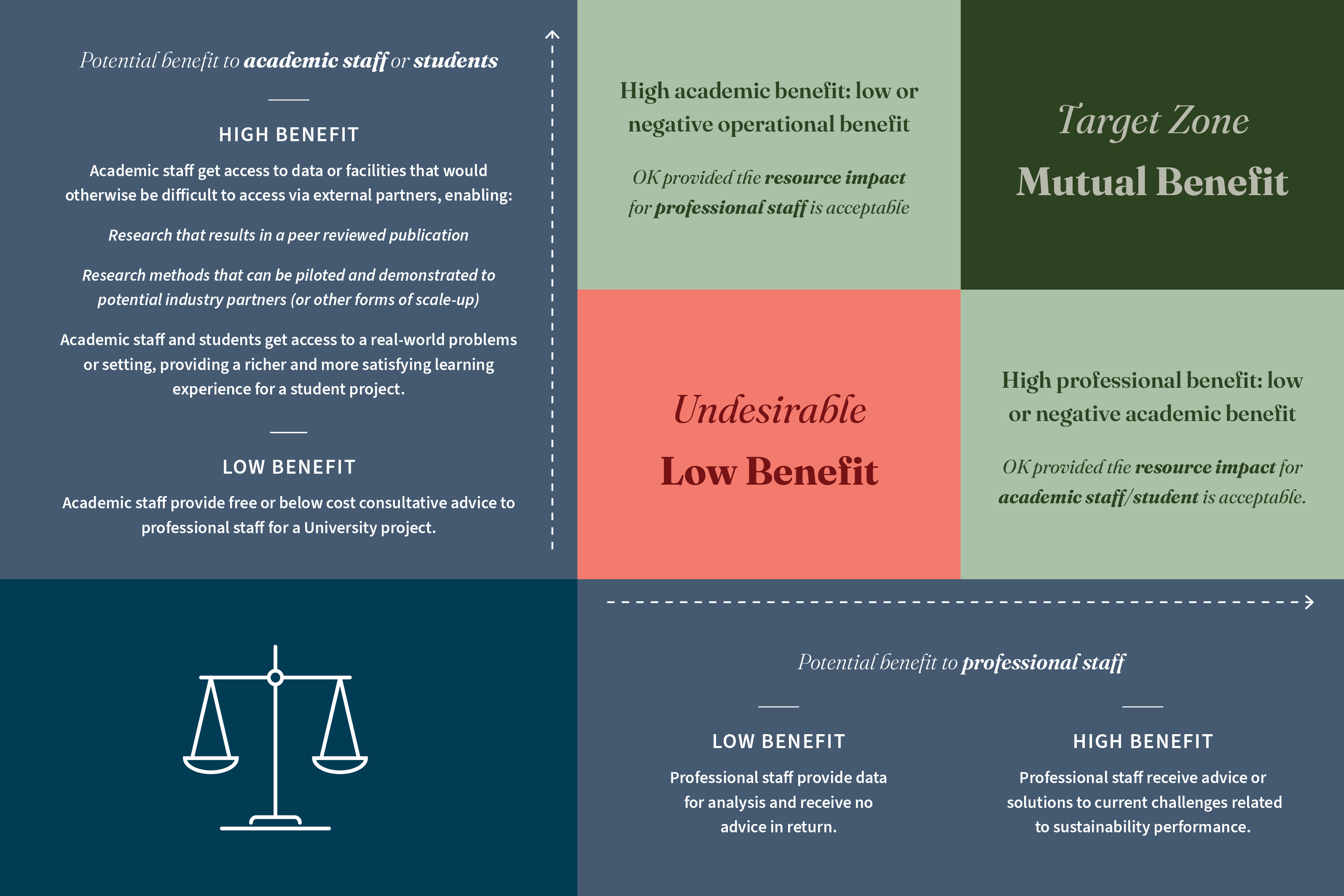
The best Campus Living Labs are those that provide mutual benefits for academic staff and students; and professional staff who have operational responsibility for the University attribute or area of focus. This requires collaboration between academic and professional staff from the start.
We strongly encourage you to connect with academic/professional staff counterparts to co-create your Campus Living Lab ideas. Please reach out to the Sustainability Strategy Team (sustainability-2030@unimelb.edu.au) if you need assistance identifying potential collaborators.
Mutually beneficial campus living laboratories
Why we support Campus Living Labs
To accelerate innovation and facilitate learning through practice, we must purposefully exploit synergies between our sustainability research agenda, campus operations and Education for Sustainability initiatives. To focus this effort, the Campus Living Lab Accelerator Program (CLLAP) provides seed funding for projects which leverage university attributes for teaching, learning and research. The goal of CLLAP is to raise awareness of the potential for living labs and build relationships between academic and professional staff, while addressing our aspiration in Sustainability Plan 2030 (SP2030), that “The University’s campuses and operations enable real-world opportunities to develop, test and apply sustainability skills and solutions.”
Campus Living Lab Accelerator Program 2026 funding round
Applications for the Campus Living Lab Accelerator Program 2025 funding round have now closed.
Details of available funding and the application process will be advertised in early 2026.