Authentic assessment transforming Visual Arts and Design teacher education
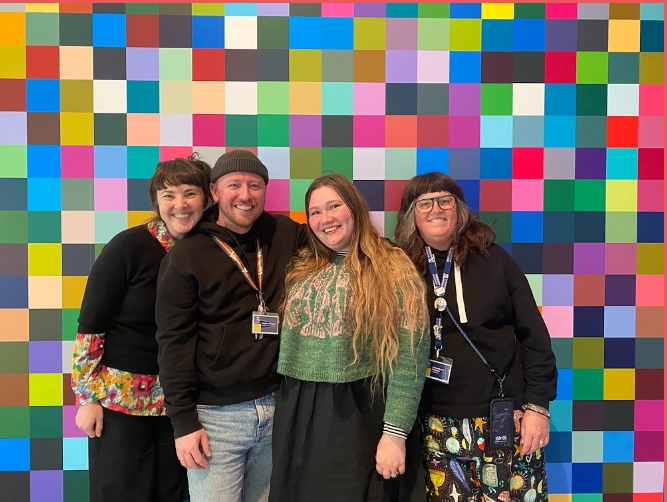
The Master of Teaching (Visual Arts and Design) (VAD) within the Faculty of Education is embedding authentic assessment into the curriculum to develop students’ work-ready skills and support their future careers.
The simple but persistent question in teacher education - how do we assess the becoming of a visual arts and design teacher, rather than simply the completion of tasks - prompted the VAD team to create the ‘Authentic Assessment in Action: Hybrid ePortfolios for the Next Generation of Teachers’ project.
Though the project the VAD team of Associate Professor Kate Coleman, Ana Ward Davies, Yvette Walker and Stephen Nicholls designed and transformed the 12-subject program in VAD assessments (course work and internship) to reflect the realities student teachers will encounter as pre and then graduate teachers, ensuring they are deeply situated in practice.
Rather than treating assessment as a series of disconnected assignments, the project, which takes a hybrid ePortfolio approach, positions learning as an evolving narrative. VAD students gather artefacts from their coursework which have been designed through accredited assessment. The artefacts are then weaved into a reflective body of work that demonstrates students' development as artists, designers, educators, and researchers at key stages in the semester. The hybrid ePortfolio assessment has been designed to be a secure form of assessment.
Authentic assessment gives students a chance to apply their theoretical knowledge in real-life situations like combining studio-based learning, professional standards and reflective practise within a single digital environment.
A creative approach for educators to connect real practice to assessment
A challenge of teacher education is the disconnect of theory, practical, and assessment coursework. The Master of Teaching VAD hybrid ePortfolio model reconnects these three learning elements, giving students a more holistic education experience and does more than simply show them what they have achieved in their design and architectural work, it helps them articulate who they are becoming as VAD teachers.
Another key innovation of the project is the integration of visual assessment in coursework. Instead of relying solely on written submissions, students curate photographs of studio experiments, sonic fragments and short videos, gifs, curriculum artefacts such as Padlets, sketches, and reflections.
This approach better reflects how creative educators think and work. More importantly, the ePortfolio becomes not just a submission for assessment, but a living professional archive that students can, and do, continue to develop as they move into the teaching profession.
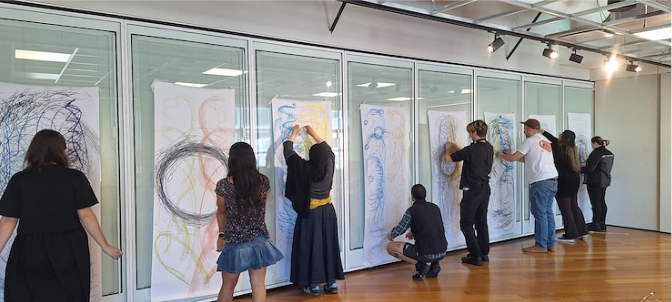
At the foundation of this innovative approach is the concept that learning is relational, critical, and creative. This sees teacher candidates participating in workshops, collaborative critiques, field visits to cultural institutions, and hands on curriculum design activities which all feed into the ePortfolio. By connecting assessment to real practice and lived experience, students are more likely to see the relevance of their work and remain deeply engaged.
Collaborative design in action
Deep collaboration within the teacher education team has been instrumental in successfully launching the ePortfolios. Crucially the project was also co-created with the teacher candidates themselves, proving insightful feedback, reflections and creative experimentation with the ePortfolio platform to help its evolution.
The project itself is reflective of a shared commitment to build a community of practice among VAD teachers, providing a platform for shared learning.
For their work, the Master of teaching team, led by Associate Professor Kate Coleman have won a LearnX Award.
Integrating authentic assessment
For other academics looking to integrate authentic assessment into their curriculum, Kate is fully supportive.
“I would love to see academics embracing assessment as a site of creativity and critical inquiry that warrants learning outcomes rather than simply measuring what someone knows at one moment in time.” said Kate.
For others looking to implement authentic assessment Kate suggests that the first step is practice.
"Authentic assessment works best when it mirrors the reality of the field. In the case of VAD teacher education, this means designing tasks that allow student teachers to plan, play, record, archive, experiment, teach, reflect and revise."
Portfolios work well because they allow learners to document their own learning journeys.
The final element of authentic assessment is trust. When learners are given responsibility to curate and interpret their own learning, they often produce work that is far more meaningful.