Meet the curriculum design team in the Faculty of Arts
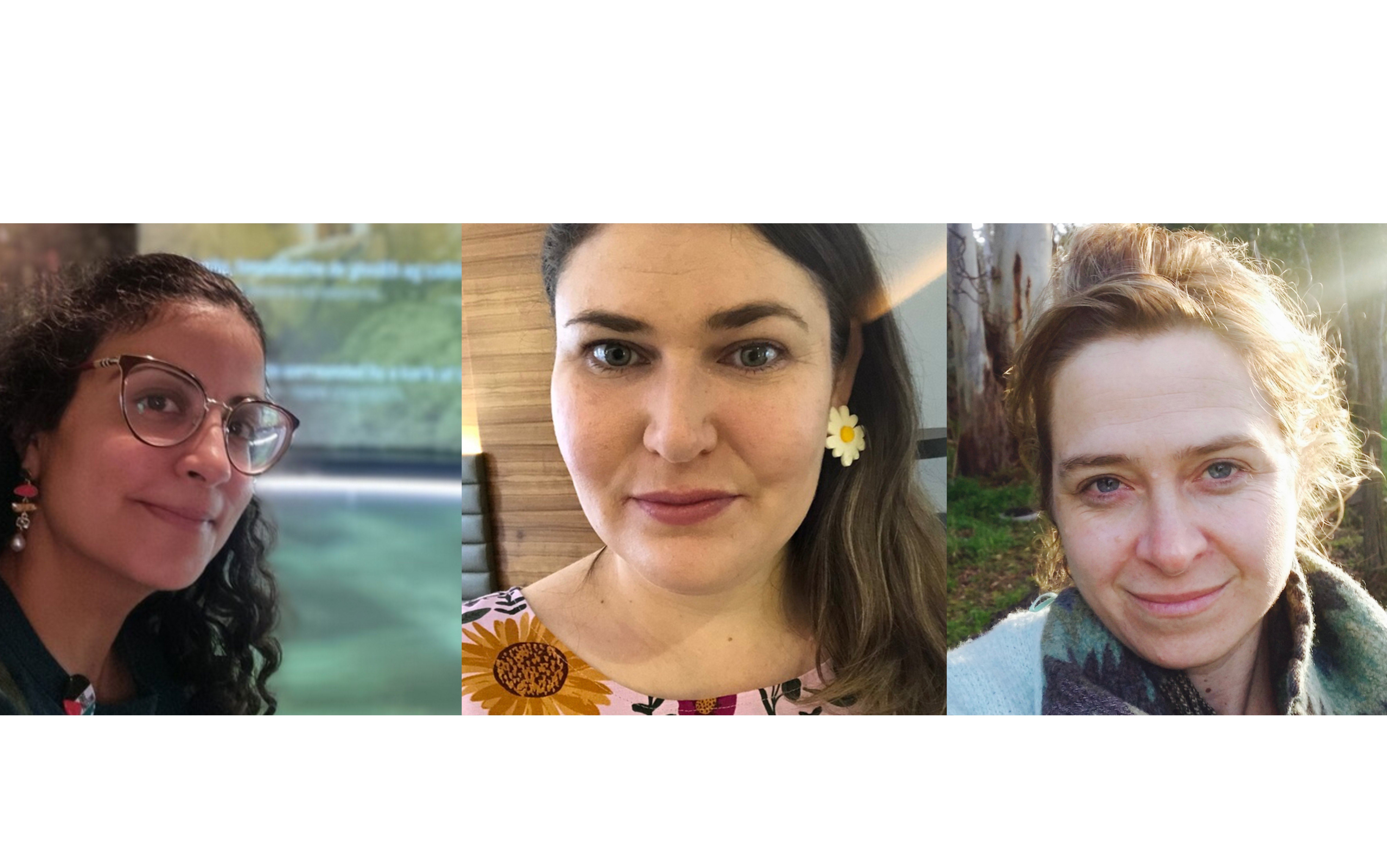
Ever wondered how curriculums are designed? Meet three of the diverse and passionate team behind curriculum design in the Faculty of the Arts.
Wajeehah Aayeshah (she/her), Kay Are (she/they) and Tahlia Birnbaum (she/her) are curriculum designers who care about innovation in teaching and learning, academic workload, and view design with an intersectional lens and student wellbeing in mind.
Wajeehah is Lecturer in Curriculum Design, Racial Literacy Program Lead and the Faculty of Arts’ Anti-Racism Working Group Lead. Kay is Lecturer in Curriculum Design and Co-convener of the Community of Inclusive Learning (COIL). Tahlia is a Teaching Specialist and member of the Staff Disability Roundtable.
Together, they work in Arts Teaching Innovation in the Faculty of the Arts and because they work as a team, it is no surprise they answered our interview questions with one voice.
What is curriculum design and why is it important?
We work with academics across 40 disciplines in the Faculty of Arts to think, plan, design, implement, and evaluate their curriculum and teaching. We liaise between the academics and service units in Arts and at university level to make sure that our design strategies are well supported, don’t overly increase academic workload, and have the best chance of working well.
Sometimes this looks like getting into the weeds on a single assignment redesign, sometimes advising a discipline on, say, secure assessment options, and sometimes collaborating on grant applications for a program-wide innovation or bringing in industry and community partnerships.
How does your teaching experience inform good curriculum design?
We all teach in different subjects in the Faculty, and maintain disciplinary and Scholarship of Teaching and Learning (SoTL) research interests to keep our curriculum design advice grounded in scholarship and in our lived, active experience of classrooms and students. Any pressures exerted on those spaces, we feel it too.
Would you say student wellbeing is at the heart of curriculum design?
Curriculum design work takes place in what is known as ‘the third space’. Our influence is directed to two levels: on-the-ground advice and higher-level discussions where we can promote culture change.
Everyone in Arts Teaching Innovation approaches the task from a different angle. We are three ATI-ers who have focussed on change-making in support of student wellbeing, student agency and students’ sense of self and belonging.
A poorly designed and delivered curriculum has a huge impact on student learning and what they take from uni to future opportunities, and impacts students’ understanding of how they might contribute to a better world. Curriculum design is foundational to students’ experience of their academic journey.
What are some examples of simple changes that could support student success?
Splitting a large final assessment task into two more feasible ones, creating assessment-clarifying instructions and rubrics, incorporating experiential and project-based learning in ways that make topics relevant to students’ lives, tweaking oral presentations to reduce student anxiety, suggesting how lecturers could interact well in a huge lecture hall – so many small ideas have big impact on students’ desire to participate, to learn, to be in the room.
It used to be that lecturers would tip their brain onto a page (or into a slide deck) and hold it out to waiting students. Curriculum design entails enhancing every point of that gesture, through conscious decision-making about how to structure, deliver, receive and engage with the content in question.
How do you measure the effectiveness of curriculum design?
Curriculum design, as a practice, needs to grow in finding better ways to measure how innovations land with students. The more precise our measurement, the more we know what good work to perpetuate, what ineffective changes to eliminate.
As part of the solution, Wajeehah has co-led a Students as Partners (SAP) project called Be Here Be Heard for about five years. This gave her an opportunity to get very close to students and really listen to insights about their learning journeys and then embed this feedback in transformational curriculum design by working closely with the academics who teach them. SAP now has a place within Schools and Wajeehah is pretty happy to see how it has progressed.
What do each of you most enjoy about your work?
Wajeehah: To me, the heart of educational design lies in its relationality. Whether it’s our relationship with people (staff or students), or space (the land we are on), or the environment (the flora, fauna, and bio-eco systems). I borrow from Shawn Wilson’s concept of ‘relational accountability’, an Indigenous methodology that advocates for questioning and reflection on how we approach research. To me relational driven lens connects a thread between social, economic, and environmental injustice, to the energy resources used on our campus, to the bottle of water being consumed in the class, and the future of job, career, as well as the planet.
Kay: I’m passionate about the much-overlooked role of the body in learning. A nervous system overrun with fear is not conducive to learning, classrooms that constrain some bodies and overwhelm others are not conducive to learning. And then there’s what we know about cognition being ‘embodied, embedded, enacted and extended’ (Schilhab & Groth 2025). Humans learn by reading, sure, but also by touching, drawing, taking breaks, breathing deeply, feeling seen, and making things with their hands.
Tahlia: I most enjoy my interactions with students. For example, I teach the Faculty Internship subject, and I love seeing students work out how to put their skills and experiences from their degree into practice. Seeing them succeed in the workplace during their placement is especially rewarding.
In terms of my role, I love that we can incorporate such a broad range of interests into our work. I might be working on an article about Acknowledgment of Country one day, then helping a student evaluate which postgraduate degree will meet their long-term career goals.
All: To help students feel they belong within rigid systems that didn’t have all of them in mind when they were invented, some pushing back is required. For all of us, curriculum design is a chance to help academics towards the outcomes they want to see, but we do this in a way that doesn’t accept the status quo, and instead questions systems and challenges them to get better, to serve all kinds of students.
Stay tuned for part two of our interview with the Curriculum Design team, where they share their thoughts on what inclusive and anti-racist classrooms could look like.