Thought starter: what does an equitable, anti-racist classroom look like?
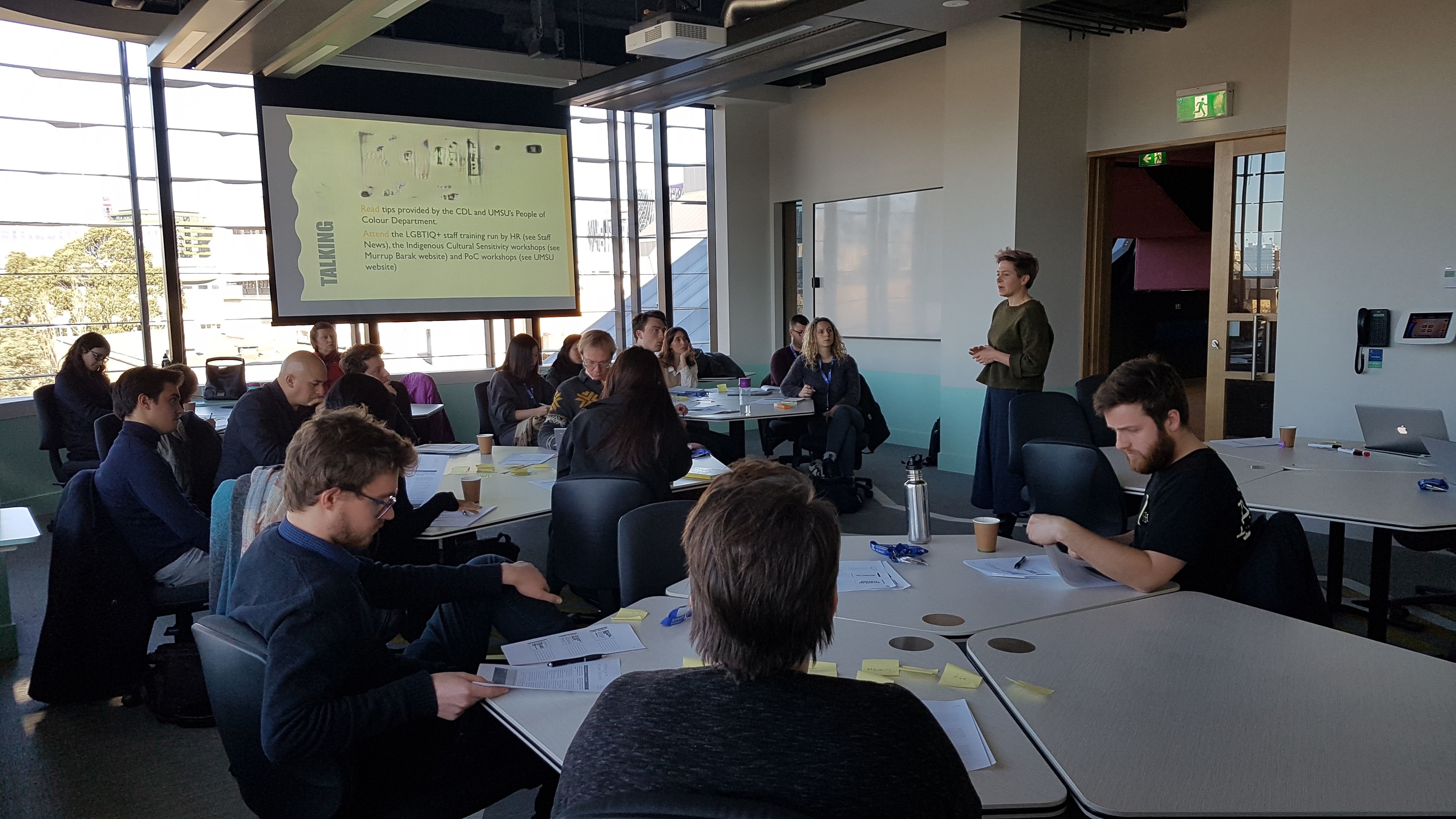
Members of the Arts Teaching Innovation team discuss how accessibility is never one-size-fits-all, and how central anti-racism is to establishing classrooms that benefit everyone.
In late 2025, we introduced you to Wajeehah Aayeshah, (she/her), Kay Are (she/they) and Tahlia Birnbaum (she/her) from the Arts Teaching Innovation (ATI) team in the Faculty of the Arts. Here we share their insights to help others create equitable classrooms. But first, we’d like to highlight the roles these inspiring curriculum designers have taken on to be of service to the University community.
Tahlia: I’m in a few different working groups and communities of practice with a focus on disability and accessibility, including the Staff Disability Roundtable, where I’ve given feedback on the University’s Flexible Work Arrangement and Workplace Adjustment processes. Being involved in different groups allows me to keep across University changes that might impact students living with disability; I can draw on my curriculum design expertise to make suggestions that will minimise impact and ensure that accessibility needs are being met.
Wajeehah: I am a Racial Literacy Program Lead for the Faculty of the Arts. I approach the word racism from a decolonial lens: anti-racism becomes all about equity broadly. Equity can only come from engaging with the history of the place and the institutions we work in, because understanding this context as a scene of racism is vital to anti-racism. Just thinking you’re not racist doesn’t make you anti-racist – keeping silent, working within the systems as they are, is a way of perpetuating injustice.
Kay: With a team of six others, I’m a co-convener of the Community of Inclusive Learning (COIL), one of the Advancing Students and Education-aligned Communities of Practice. In the year since our founding we've gathered and connected 230 members around a shared interest in supporting students to feel they have agency in, access to, and ownership of their learning. I also co-run a reading group where we share practice and research and try to alleviate the feeling that working for equity in education means working alone.
What is one simple thing anyone could do to make a student's learning experience more equitable and enjoyable?
Tahlia: At the beginning of semester, invite students to approach or email you with their accessibility needs so that you can make an effort to accommodate them. Avoid judgment and don't discriminate between wants and needs.
Kay: The simplest thing to do would be to make it known on day one that you value students’ input and that it will genuinely be heard. This is because students being able to relate content to their own experience and communities supports deep learning – and, indeed, strengthens the future of our disciplines. But even before semester, it’s worth looking closely at your curriculum to see where the opportunities are to structure-in attentiveness and exchange. ATI is all about helping educators do this and we love chatting with them about their ideas!
Wajeehah: Use your positionality, the unique mix of your social and cultural background, your worldview, and the space you occupy in the world, to build a genuine, human connection from day one. Share some examples of where things were challenging for you – how did it make you feel? What did you do to overcome this? You can also share when it just didn’t work. Make sure that the students understand that you stand there with your very unique vulnerabilities and strengths, and that they are all invited to bring in their unique personalities. Most importantly, be sincere and genuine about it. Students are clever and usually they can see through you if you are putting on a show.
What does an accessible classroom look like?
Tahlia: I don’t necessarily know what an accessible classroom looks like for everyone – I'm still learning, and everyone will have different accessibility needs. For me, accessibility includes things like clean filtered air, access to water, and adequate seating. For others, it might include ramp or lift access, a room close to accessible parking, the use of a microphone in the classroom, or direct access to somewhere quiet. I think it's important to invite people to let you know what their accessibility needs are, see what you can do to meet those, and regularly check that they are being met.
Kay: When institutions talk about ‘people with access needs’, they forget that all of us, of course, have access needs. Many spaces are set up in a way that allows some people not to notice that their needs have already been tailored to and met with the space design. We will have ‘accessible classrooms’ when nobody needs to think of themselves as having ‘additional needs’. But we can’t wait for buildings to be rebuilt. Curriculum design can help educators to create an environment that adapts the built space to the need that all students have - to feel welcome and present, and therefore ready to study.
Tahlia: Exactly, making accommodations that make people feel more welcome and comfortable generally end up benefitting everyone!
What does an anti-racist classroom look like?
Wajeehah: An anti-racism classroom is a space that is built on a clear understanding of historical, social, economic injustice. It is a space in which racism is actively counteracted, through language – both verbal and non-verbal – through decolonised content, through curriculum design delivery. This space needs to be customised to the participants.
The important thing to remember is that we don’t have to make huge, time-consuming changes to the classroom. We start small by ensuring students names are properly pronounced. We start with a relational driven approach towards teaching.
Getting a grasp of some preliminary foundations and then continue to evolve as the conversations go. For example, deciding on the readings/text for your class, we can check how many non-English origin sources you have? A good example of an anti-racist subject is that of Indigenous Astronomy (PHYC10010). Is there anything that you can teach around similar lines?
Once we know the students, we can see how many sources come from the same origins as the students themselves. We can invite students to bring in their own sources as well. An anti-racism classroom allows for co-creation, and student agency.
Another thing we may want to do is to use multimodal texts – readings, videos, graphic novels, interactive games, songs, poetry, fiction and non-fiction. There are different ways of teaching content. Multimodality allows for a more engaging ways that is respectful to different cultures and traditional knowledge delivery.
The third thing is to continue learning and sharing this learning about how racist or anti-racist our education is. We can also discuss real-life examples about privileges that our socio-cultural-economic positionalities offer or take away.
To learn more about teaching and curriculum design to support belonging, the team recommends this Times Higher Education article, called Doing DEI when you Can’t Use the D, the E or the I Word
We invite University of Melbourne staff to share your thoughts on how to build accessible, anti-racist classrooms on Viva Engage.