Teaching Dante’s Inferno with virtual reality
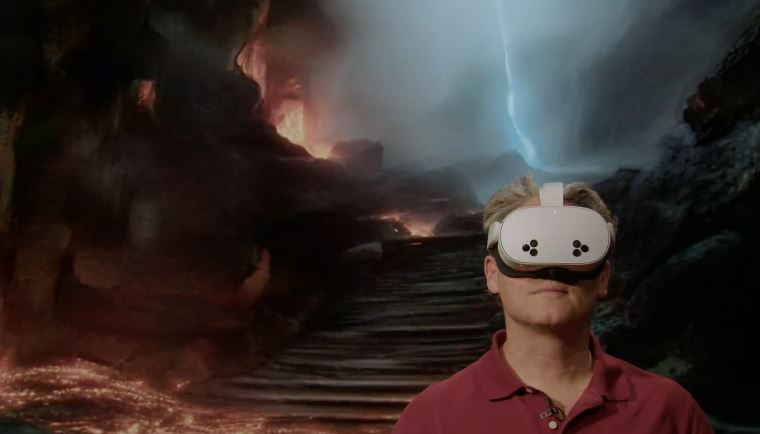
How Elisabetta Ferrari and Mitch Buzza from the Faculty of Arts brought Dante Alighieri’s poem Divine Comedy (Inferno) to life through virtual reality (VR).
The Italian capstone subject ‘To Hell with Dante’ focuses on the study of Dante Alighieri’s poem Divine Comedy (Inferno), the most important Italian literary work, and one that has had a profound impact on Western thought, culture, and the concept of humanism.
Elisabetta Ferrari, Senior Lecturer in Italian Studies, and Mitch Buzza, eTeaching Support Coordinator, worked together to create a virtual reality experience to enhance students’ learning, engagement and understanding of the text.
The idea was sparked from two previous VR projects, embedded in other Italian subjects, where students experienced a reconstruction of famous moments in Italian history (Garibaldi’s Expedition of the Thousand and the architecture of the Fascist regime). Student responses to these VR were overwhelmingly positive, so Elisabetta and Mitch decided to expand their approach.
Enhancing the curriculum with VR
As part of a curriculum uplift, the ‘To Hell with Dante’ subject was redeveloped with the support of a Next Generation Capstones Initiative Grant. The grant funded both research and the VR project, bringing experiential learning activities, authentic and contextualised experiences, and a focus on critical enquiry and creativity to the subject.
The aim was to create an experience that wasn’t superficial but instead offered meaningful depth and genuine value.
“Projects like this are an opportunity to explore and share our own creativity with students, and to inspire them through a novel approach that embraces our changing educational environment” said Mitch.
There are many pedagogical benefits in using VR in the classroom, particularly in language subjects. VR enables students to engage more authentically and realistically with cultural and social aspects of countries that are often far away or not otherwise accessible, as well as with historical periods and texts from long ago.
As a core component of immersive and experiential learning, VR supports deeper understanding by situating learners within realistic or reimagined environments. While VR experiences can be viewed on a standard 2D screen, their impact is greatly enhanced when students watch them through a VR headset.
Creating the Inferno
Elisabetta and Mitch quickly identified that Dante’s Inferno was an ideal text to be adapted for VR.
“This poem has been visually reimagined and represented throughout the centuries and discusses very topical issues like trust, morality, love and politics. The scenes described in the poem’s cantos range from strangely beautiful and windswept, to foreboding and darkly ghoulish. These aspects make the Inferno the perfect text to be adapted for a VR immersive experience” Elisabetta remarked.
Planning the experience involved creating storyboards of the poem, exploring different ways of interpreting the text visually, and scripting four episodes from various cantos with scene descriptors, soundscapes, and narration.
Elisabetta and Mitch worked with Latitude Video Production who used the scripts and details to create the VR experience. This close collaboration was key to achieve an imaginative visual style.
Artificial intelligence was also used to create some of the imagery, the skyboxes (dynamic 360-degree backdrops, and elements of animation, helping to bring illustrations created by Gustave Doré in the Eighteenth hundreds to life. This helped to keep costs low and access some of the previously expensive and highly specialised features of VR.
Colleagues from across the University contributed voiceover narrations, in English and Italian, with support from Gavin Nebauer at the University’s Horwood Recording Studio.
“Collaboration was fundamental for this project. It allowed us to draw on the expertise and creativity of colleagues within and outside the University. And it’s fun! Connecting with colleagues, sharing the creative process is just as important for our work as the learning experience is for our students” Elisabetta said.
Student response to VR
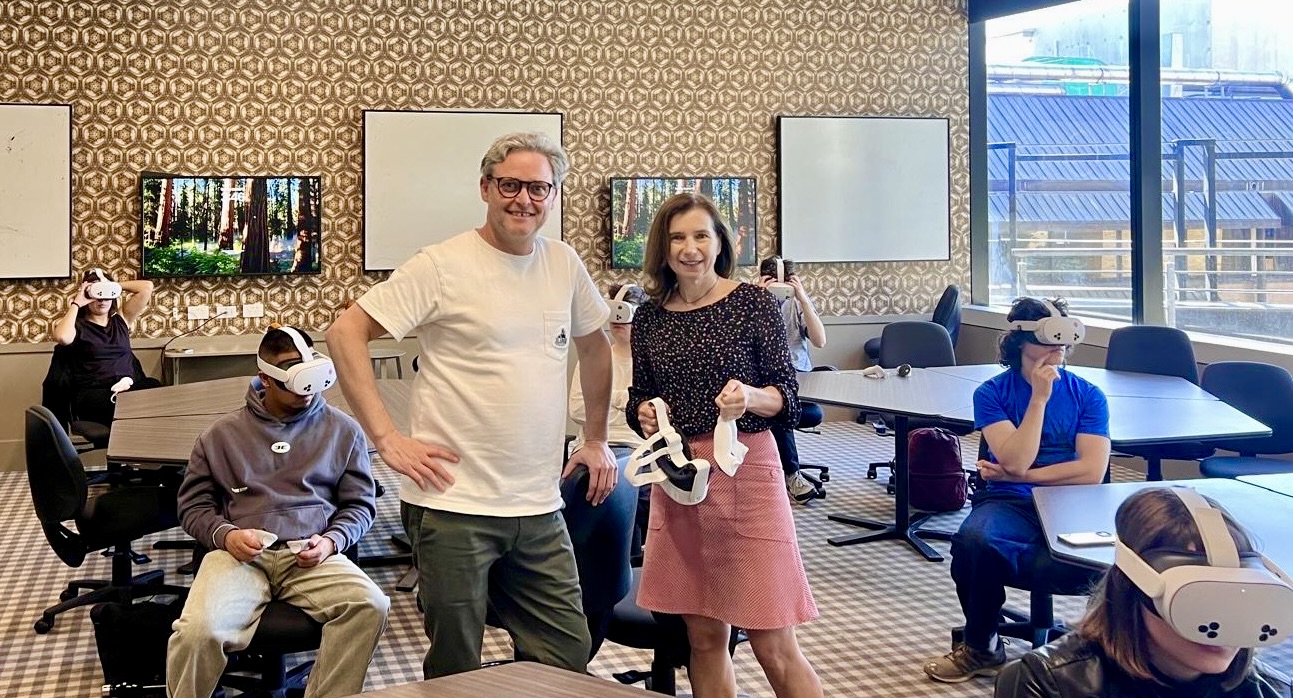
Students could undertake the VR experience either in Italian or English during the final weeks of the semester, after close study of the sections of the poem included in the VR video. Headsets were brought into classroom, allowing students to experience the immersive and beautiful virtual environment simultaneously.
Following the experience students were visibly engaged and enlivened. The discussion that followed pushed their language skills to describe the novel experience while critically engaging with the poem, linking the literary text with the contemporary technology.
Students found the immersive aspect exciting, many commented that the experience allowed for a deeper engagement with the material and, in doing so, helped to bring the text to life in new and meaningful ways.
Advice for bringing experiential learning into the classroom
Elisabetta and Mitch’s key advice for educators interested in experiential learning is to be creative and daring about it.
“There are so many opportunities for experiential and immersive learning through VR and digital technologies, and they really add value to teaching and to students’ experiences” shared Elisabetta.
They suggest experimenting first-hand with what VR has to offer and then consider the ways it can be implemented into teaching practice.
“Many teachers may have tried VR in the past, in a more simplified version, when it often meant popping a phone into a cardboard viewer or a very basic headset. It is a very different technology now, with rich visual and sound quality, and plenty of variety in the methods of creating the learning assets. From ‘easy and achievable’ to ‘complex, realistic and highly customisable’ and all can be high impact and engaging” Mitch added.
Find out more about creating the experience in the video from Elisabetta and Mitch.