University teachers recognised with three national awards for teaching excellence
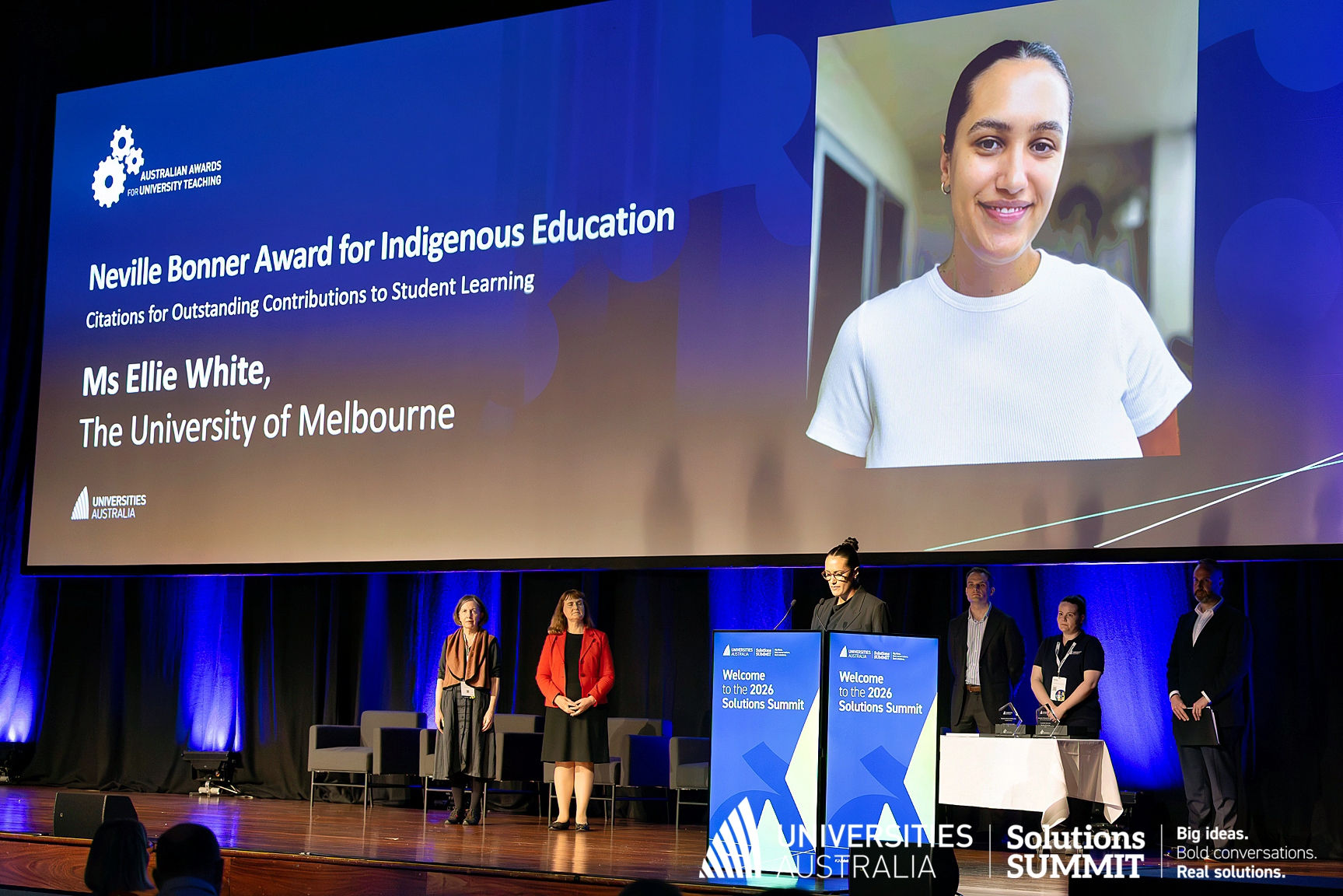
University of Melbourne teachers have been awarded three 2026 Australian Awards for University Teaching (AAUT), a prestigious national award overseen by Universities Australia.
The annual awards recognise the impact that educators have on the learning and teaching experiences of students, celebrating the outstanding programs and educators that shape the student experience and the future of the higher education sector.
Ms Ellie White from the University of Melbourne’s Faculty of Medicine, Dentistry and Health Sciences was awarded the Neville Bonner Award for Indigenous Education with a ‘Citation for Outstanding Contributions to Student Learning’.
Ms White has been leading transformative health education that celebrates Indigenous ways of knowing, shaping emerging health professionals to be strong advocates for health equality. Her award was celebrated at the Universities Australia Summit in Canberra on 24 February, where Ms White was invited to speak to an audience of university, sector and government leaders.
Drawing on her own lived experience she has transformed the learning environment in the Doctor of Physiotherapy program at the University, redesigning the Indigenous curriculum.
“It is a real privilege to have my work, and that of the broader team, recognised with such a prestigious award at a national level.” Ms White said.
As she reflected on the impact of her work, she hopes the path she’s helping to shape will lead to lasting change in healthcare and education.
“Looking ahead, I hope my work helps contribute to creating healthcare spaces that are genuinely accessible, culturally safe and equitable for First Nations peoples. Whereas in education, I am hopeful for a future where celebrating First Nations ways of knowing, being and doing is embedded as part of standard teachings, rather than the exception.” Ms White said.
In addition to Ms White’s award, a team led by Professor Eddie Cubillo from Melbourne Law School was awarded a ‘Citation for Outstanding Contributions to Student Learning’ and a team led by Associate Professor Stuart Barber from the Faculty of Science was also awarded a ‘Citation for Outstanding Contributions to Student Learning’.
Professor Cubillo and Ms Jaynaya Dwyer, with the exceptional project support of Ms Elyse Keyser, were recognised for their leadership in developing on-Country Indigenous justice pedagogies for Australian legal education.
For the past three years the team have co-taught two innovative and nationally significant on-Country legal education subjects through the Indigenous Law and Justice Hub at the Melbourne Law School.
These traveling education experiences immersed students in place-based, relational learning on law and justice, grounded in Indigenous legal authority, and addressed a critical gap in Australian legal education, where the compulsory curriculum excludes Indigenous law and jurisprudence.
Associate Professor Barber led the ‘virtual farm tours’ team, including Evan Hallein, Dr Rebekah Brown and Associate Professor Vern Bowles, which was recognised for their creative and innovative work in broadening access to authentic learning experiences through the virtual farm tours.
The program of virtual farm tours, which originated in 2011, expanded into the internationally recognised 4D Virtual Farm and DookieVR platforms.
The farm tours allow students to explore farming enterprises in an immersive way and address significant barriers to work integrated learning, including costs and travel, seeing an increase in student engagement, confidence, employability, and access in agricultural and veterinary sciences.
Associate Professor Barber is celebrating his 20th year in his teaching and research role in the Melbourne Veterinary School and shares how the recognition of this project in the education sector may help continue this work and help transform education.
“We've been fortunate to win awards from the broader agricultural industry as well as technology and they’re both really good, but recognition of the impact within the education sector is also important. Hopefully, this will help drive the project forward so that we can continue with the work and maybe utilise it more broadly both in tertiary, but also maybe in secondary schools and other forms of schooling.” said Associate Professor Barber.