In conversation session 2: How can we be brave, and feel safe?
As part of our ‘In conversation’ series, providing a forum for respectful dialogue on issues of interest for the University community, a discussion was held on Wednesday 16 September focused on: ‘How can we be brave, and feel safe?’.
Sponsored by the Interim Provost, these events bring together staff and students to consider the kind of University community we wish to create.
Co-hosted by Professor Lesley Stirling (Academic Lead, In Conversation series) and Amila Premakumara (President, Graduate Student Association), the event drew on expert discussion from:
- Justin Zobel – Redmond Barry Distinguished Professor
- Travis Lovett – Executive Director, Centre for Truth Telling and Dialogue
- Jess Nithianantharajah – Professor in Behavioural Neuroscience and Head of Florey Department of Neuroscience and Mental Health
- Jac Tomlins – consultant, LGBTIQ+ community leader, and social change advocate
An extensive and poignant discussion considered such questions as: what happens to our bodies when we feel under threat; how can we sit with discomfort; what is transitional safety when joining the university; how can we be brave in our interactions with one another; and how can we manage the tension between feeling safe and being brave.
Amila opened the discussion by asking Jess to talk about what happens when our bodies feel under threat. Jess shared insights from her behavioural neuroscience perspective around how our brains and bodies are interconnected, and they work to explore, process and understand the world around us. When exploring between safety and threats, the 'fight or flight' response is a great example of how our brains and bodies can rapidly react when it receives information from the world about something that is perceived as threatening.
Jess commented: "What the brain is trying to do is help predict what might happen next in a given situation, to help inform what might be the best possible response at that time. And what I want to share is that whether we feel in control, what we think are threats, and what we think is safety, are in part…learned experiences. Our previous experiences shape how we respond in new situations, but importantly, these responses are not static, they are highly adaptable."
The discussion then moved to asking Jac to share some experiences from sitting with discomfort and engaging on difficult topics. Jac talked about experiences on many occasions with politicians, civil servants, staff in large organisations and faith leaders. Jac noted: "We have to talk with the people who disagree with us. If you want to shift people's thinking, their behaviour, their vote, we have to actually sit down and talk with them and have a conversation. And I often find that people are very reluctant to do that."
Jac talked about the simple idea that people don't hear unless they've been heard and highlighted the importance of listening more and talking less. Jac also touched on the crux of the issue being the difference between what's uncomfortable and what's unsafe.
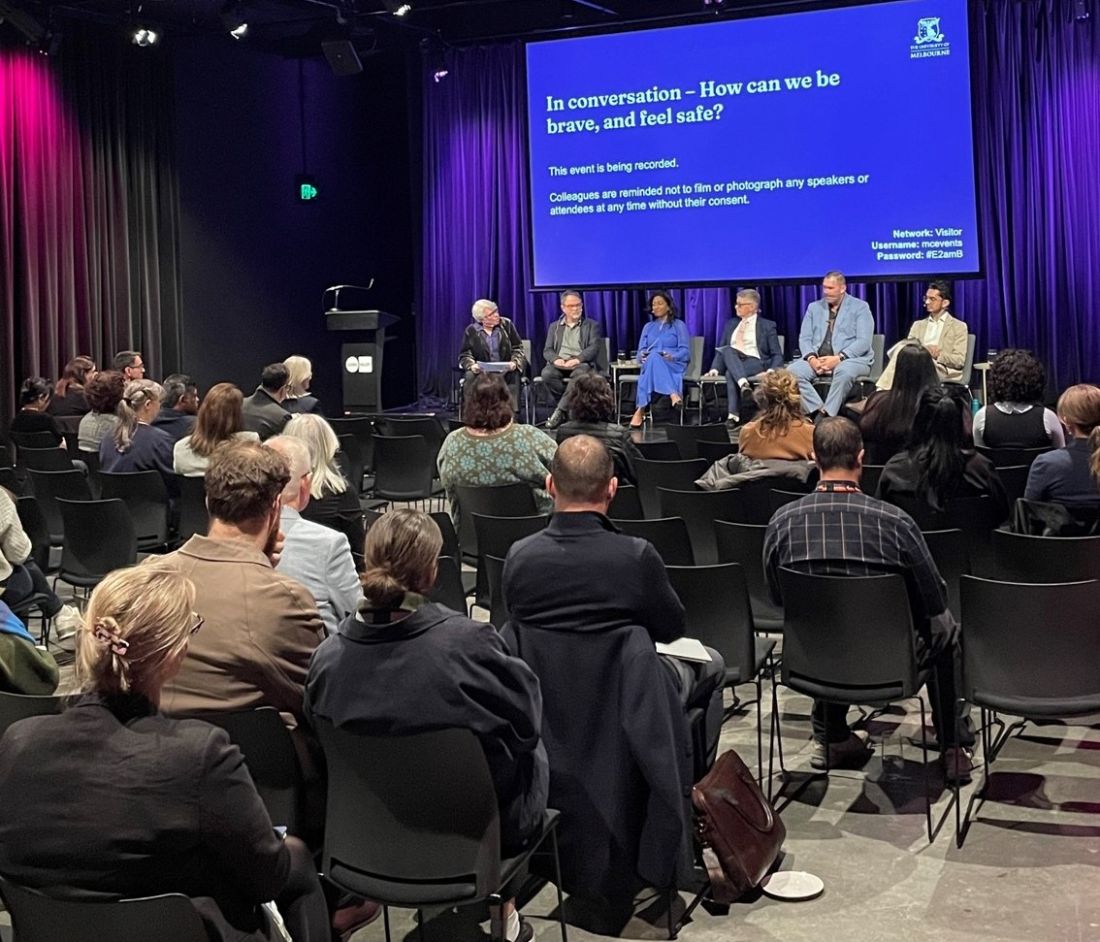
(Photo: audience members listen into the panel discussion)
Amila then asked Justin to expand on the concept of transitional safety, in light of Justin's experiences working with students from different cultural backgrounds. Justin talked about the challenges students can face when first arriving on campus. He remarked that some students may not know what to benchmark their experience against and how this can make them feel unsafe if they are making judgements based on practices from different societies.
Lesley then asked Trav to share some insights around how we can be brave in approaching the interactions we have with one another, based on his experiences involving conflicts between people.
Trav spoke of the importance of having the ability to create safe spaces for lived experience, and the importance of accountability. He emphasised the role that institutions and leaders have in creating opportunity for igniting difficult conversations and space for community to come together. Drawing on his experience in truth-telling, Trav also reflected on the importance of First Peoples being able to share their truths and lived experiences and have them heard and respected.
Trav said: "If we don't tackle the issues, the hard conversations, creating the space to be able to do that, people won't be accountable". Trav also talked about the importance of having strong institutional mechanisms in place for people to be accountable and for processes to be transparent.
Before opening up to audience questions, Lesley asked each panellist to briefly comment on 'what does it mean to be safe for you? And is there a tension between feeling safe and being brave?'. Comments included feeling safe being about knowing who you are and what you stand for, feeling well informed and understanding how you relate to a situation.
Jess commented: "Bravery isn't about the absence of fear... fear is a biological response. It's there to protect us. But it's about how we create environments that are safe enough in order to empower people to take those risks, to develop that trust and connection." Justin added that bravery "is about the preparedness to be uncomfortable". Trav reflected that feeling safe includes being respected, while also being prepared to listen to and learn from others. He emphasised the importance of reciprocity in creating the conversations and dialogue needed to move forward.
The discussion then moved to audience questions. The first question noted personal experiences of a disconnect between what the University says and the behaviours that are witnessed, and asking how, as a University, we can change the culture in everyday interactions.
The panel offered insights around this being the difference between having really good policies in place and how those policies are actually enacted, alongside comments around how the University can strive to create safer environments and take the time to reflect as a collective.
Another question asked Jac to share the best success story of changing someone's mind, where at the start it was challenging but ultimately, it worked. Jac talked about some of the most significant experiences being in the faith space where, even in half a day, Jac has seen significant shifts in opinions. Jac talked about giving people safety and allowing them to speak and seeing shifts happen often in such environments.
A final question was then asked about accountability and the willingness to be flexible in the way that we pursue solutions and innovations. Trav spoke about having conversations to listen to lived experience but also updating policies and programs for institutional accountability. Trav reflected on the importance of creating processes where people feel heard, supported and taken seriously, even where a particular outcome cannot be guaranteed. He also highlighted the importance of learning from what works and using those experiences to improve and transform systems, rather than simply relying on established processes.
Returning to panel discussion, Lesley asked Amila what kinds of stories graduate students share about their experiences of feeling safe or unsafe, and of needing and managing to be brave.
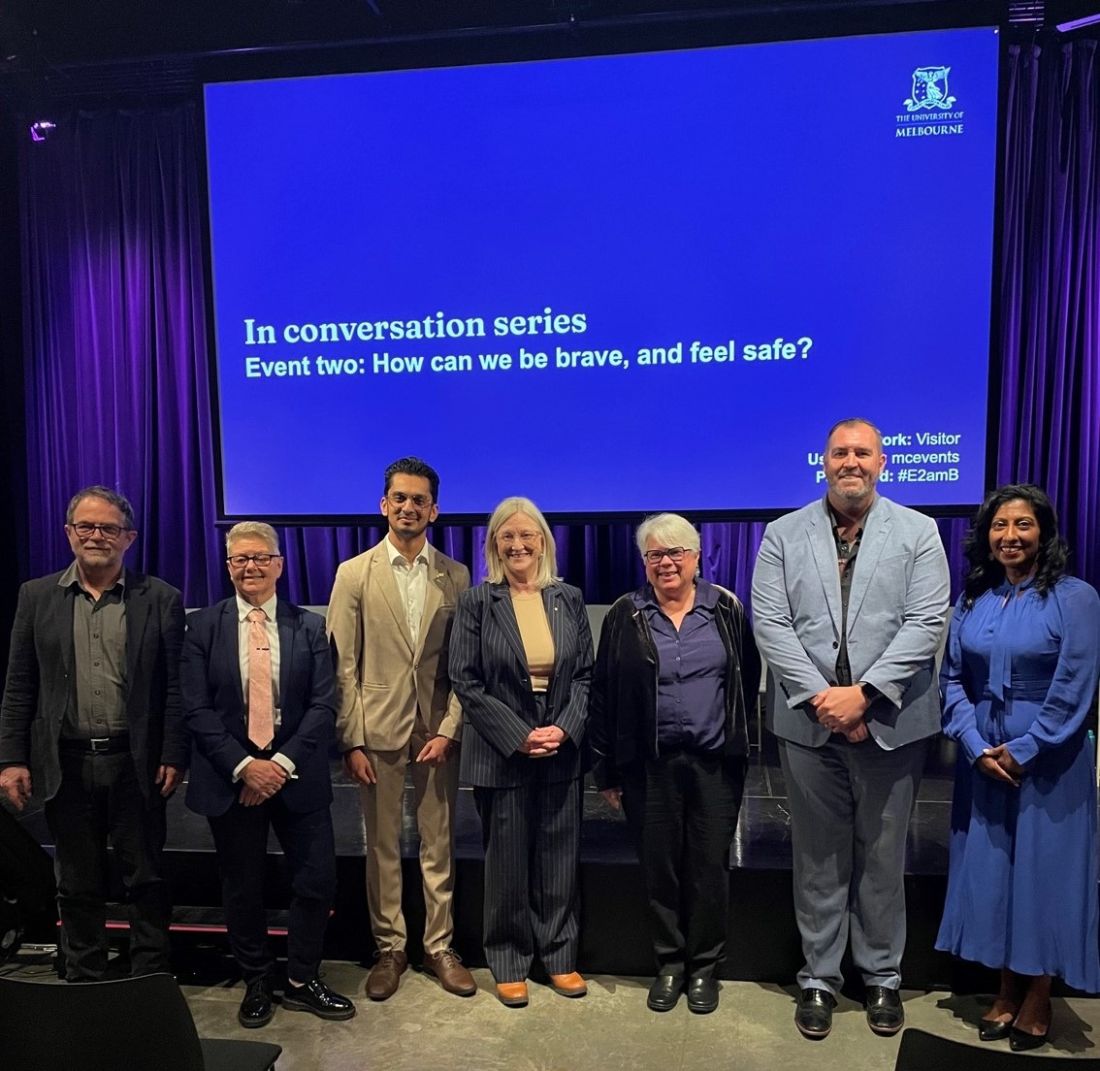
(Photo: pictured L to R, Justin Zobel, Jac Tomlins, Amila Premakumara, Jane Gunn, Lesley Stirling, Travis Lovett and Jess Nithianantharajah).
Amila commented: "What we hear as GSA is the fact that people know what to talk about, but they don't know how to bring it up." Amila outlined some power imbalance situations and students’ hesitation to speak up in these scenarios. The Graduate Student Association is trying to develop skills to help students in this way, but Amila noted there is a lot of culture change that needs to happen in the University and beyond.
Trav and Amila then had a discussion about where the student voice is able to influence decision makers and Amila outlined the many committees across the University that GSA representatives sit on, confirming that all of these committees’ welcome student voice as equal. However, Amila noted the GSA representative in each instance is representing 40,000 graduate students and not everyone has that same opportunity. Trav prompted further reflection on the distinction between having a seat at the table and having genuine power and authority within decision-making forums, asking whether people feel able to speak their truth when significant power imbalances remain.
Jess added that the University is listening, and hearing these comments from graduate students, and is actively working to create the structures to empower graduate students to build the networks and skills they need. Lesley asked Justin to share his perspective of how students can self-advocate and Justin noted: "Self-advocacy is the flipside of danger and uncertainty". Justin reinforced the other panellist's comments about finding a network, finding people to speak for you, and highlighted the importance of data.
As the final question of the panel discussion, Lesley asked Jac to share what it means to feel triggered and to touch on trigger warnings. Jac talked about trigger warnings being a message to the brain that is just information and gives a person a chance to think about what to do next. This is an important function of the prefrontal cortex in the brain. Having that moment to think before acting is actually empowering. As Jac noted: "It gives me back some power, some control, some agency". Jess commented that what is a trigger for one person is going to be different for another.
A question from the audience then asked given the prefrontal cortex isn't fully developed until the age of around 25 years, and a significant part of our community is under the age of 25, are we doing enough as a University to educate people about this? The panel observed that there are pockets of work currently engaging with this, and highlights a strength that the University has rich knowledge and expertise at our fingertips and there are likely programs that can be created to delve into the neuroscience and further share these learnings.
To close out the session, a reflective response and summary of the discussion was provided by PhD student and President of the University of Melbourne Iranian Society (UMIS) Amir Fila. Amir reflected that for graduate researchers, feeling safe enough to speak up isn't always straight-forward and the power imbalance can be subtle. If we are going to move towards a safer environment, it requires agency. And small decisions count.
Amir said: "A healthy university should be a place where we can challenge one another without trying to silence, label or intimidate one another." Amir also spoke about accountability and shared responsibility and the fact that "culture is rarely the result of one grand decision. It is built through many small decisions made consistently where we try to do the right thing, even when the issue seems insignificant."
A reminder was provided to all attendees that the Safer Community Program operates Monday to Friday between 9am and 5pm. Thank you to everyone who took the time to attend and participate in the discussion.
Previous discussions:
- 2025: Trust
- 2025: Disagreement
- 2026: How can we act for good?