Baillieu Library Special Collections Redevelopment
Overview
This page provides an overview of plans to redevelop parts of the Baillieu Library, and explains change in access to some collections to enable the uplift.
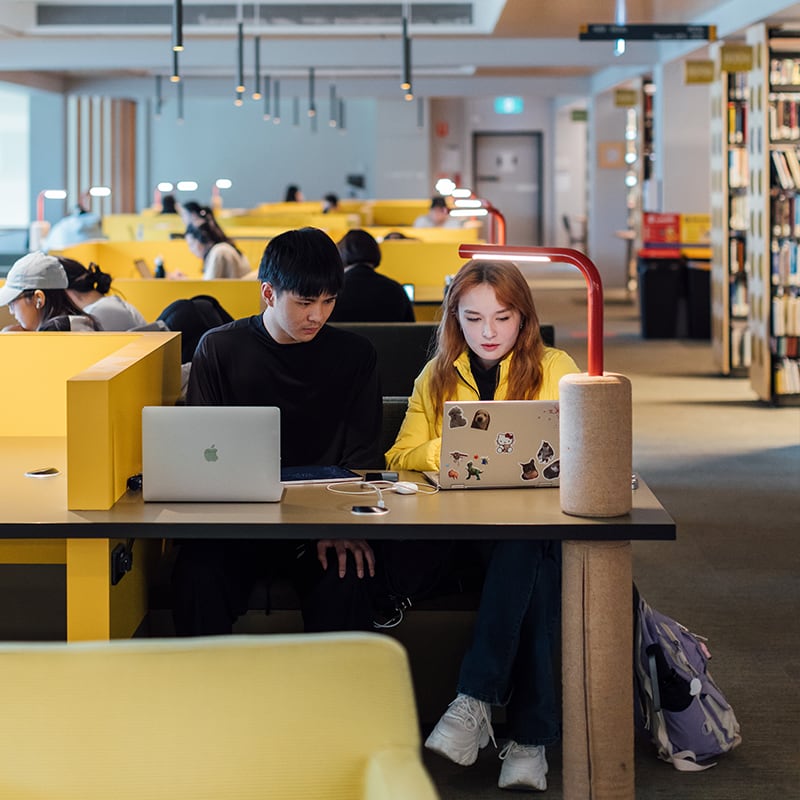
The Estate Master Plan identified the redevelopment of the Baillieu Library Special Collections as a Priority Project, adhering to the strong imperative to retain the University’s valued Special Collections in the Baillieu Library.
In Stage 1, Special Collections will be rehoused within the Baillieu Library in a fit-for-purpose storage environment with fire protection, security and environmental controls commensurate with their value and significance.
Additionally, the staff, student and visitor library experience will be enhanced in Stage 2 by:
- A new world-class reading room, exhibition space and object-based learning space (Level 1): enabling deeper engagement with Special Collections through a new world-class Scholars’ reading room, an enhanced exhibition space, and contemporary object-based learning spaces.
- Uplift of informal study spaces (Level 1)
- A new Graduate Study space (Level 3): a dedicated Graduate Study space to support graduate students.
Delivery
Construction commenced 17 November 2025, with Stage 1 anticipated completion in December 2026. Funding for Stage 2 is pending the University investment process, which will be determined late 2026. These are indicative construction program dates supporting a staged delivery to ensure the Baillieu Library can remain open during this time.
Design Renders
ARM Architects are the Principal Consultants lead design team, under the close guidance of the Scholarly Services team. We are excited to share some artist impressions of the uplift.
Please note: these are artist impressions only and are subject to change.
Maintaining the Library Experience During Construction
We are committed to preserving the library experience during construction by:
- keeping the library open and usable throughout construction
- continued access to library resources through alternative arrangements
- controls to minimise distractions caused by construction.
The Lower Ground is now permanently closed, however collections, alternative study spaces and Microform readers remain available. Read all the details below!
Construction of Stage 1 commenced on 17 November 2025, with anticipated completion in October 2026. Delivery will be staged to ensure the Baillieu Library can remain open during construction.
- Stage 1 – Nov 2025 to Dec 2026: Lower Ground refurbishment to rehouse Special Collections
- Stage 2 – pending confirmation of the 2027 Capital Plan: Concurrent refurbishment of Level 1 and 3
These program dates are indicative, with funding to be confirmed for Stage 2. Any significant changes in the program will be communicated.

The Lower Ground is now permanently closed, however collections, alternative study spaces and Microform readers remain available:
- The Lower Ground has been cleared with low-use collections relocated to offsite storage in July 2025, retrievable within 2-business days via the library catalogue. Materials remaining in the Baillieu Library have been interfiled into the collections housed on Levels 2 and 3.
- Alternative informal study spaces can be found on all floors of the library. You may also wish to explore a range of other informal study spaces available on campus, including other libraries on the Parkville campus.
- Microform readers can be found on the Ground floor.
Collections:
- Please read below to understand a temporary change in access to Special Collections, and how to make alternative access arrangements.
- Please read below to understand which low use general collections, periodicals and Microfiche/Microfilm be moved to offsite storage, with a two-business day retrieval period.
A disruption management plan is in place with controls to minimise disruption, including:
- A staged delivery, keeping as many spaces open as possible
- Conducting excessively noisy or disruptive works outside the hours of 8:30 am-5:00 pm Monday to Friday, and 11:00 am-5:00 pm Saturdays, or during semester breaks
- Keeping the main stairwell and lifts available for exclusive use by library users
- Installing temporary timber hoarding around construction zones to limit dispersion of dust and noise
If you wish to speak to a member of the University’s project team, please contact Phil Brady, Project Manager via phil.brady@unimelb.edu.au, or for more urgent matters please call 0432 549 396.
Baillieu Special Collections: Temporary Change in Access
It is crucial that we protect the library’s Special Collections during their relocation to the refurbished Lower Ground. Special Collections will be stored safely within the Baillieu Library to prepare for their relocation, restricting their access from approximately 15 June 2026, with gradual re-opening throughout Semester 1 2027
The Reading Room will remain open throughout Stage 1.
Importantly, professional removalists with experience and skills in handling books and Special Collections have been engaged to pack and move our collections next year.
We understand that the disruption to service during this period will require alternative arrangements to the use of Special Collections for teaching, learning and research. We are committed to working with the University community to collaboratively establish alternative arrangements that strive to minimise disruption.
Every effort will be made to ensure there is no disruption to this service for teaching, learning and research during their relocation, however this can only be achieved by request and with sufficient time to prepare. All users of Special Collections are urged to make alternative access arrangements before the end of May 2026.
However, many alternative arrangements are possible, with prior digitisation of content providing the optimal temporary solution. Options include:
- Continued access to Special Collections at the Baillieu Library for OBL and research: Uninterrupted access can be arranged for critical items. With limited space, this can only be achieved for select items. Only items identified through this process will remain available.
- Prior Digitisation of Materials: The library team can create digital surrogates that offer the best alternative for teaching, learning and research purposes.
- This work takes time and must occur before the end of May 2026.
- From 1 June, on-demand digitisation will not be possible until Semester 1 2027, as collections will be inaccessible.
- Use of Existing Archival Material and UMA Collections: Where relevant, we encourage utilising archival materials, which will remain fully accessible for research and teaching.
- Collection-Agnostic Teaching Support: This may include:
- Visual Thinking Practices: Engaging students with available materials (from archives or digital surrogates) to explore how they visually communicate complex ideas.
- Peer-to-Peer Engagement: Facilitating discussions where students compare available collection materials.
- Vocational Skills Development: Teaching students how to interpret, exhibit, handle, preserve, and communicate the significance of artworks and collection items using accessible resources.
- Curator Expertise: Curators can prepare in advance and bring their expertise to classes, possibly using digital surrogates as reference materials.
If you have not made alternative arrangements yet, the ASC team is available to assist you in establishing the best alternative arrangement for your needs. Please contact Kathryn Hore, Associate Director, Archives and Special Collections to commence preparations.
Alternative arrangements for use of Special Collections in the Reading Room must be made before May 29 2026.
Alternative arrangements for use of Special Collections for teaching and learning must be made before 5 June 2026.
Select Collections Have Now Moved to Offsite Storage
To enable Special Collections to be housed in the Lower Ground, it was proposed that low use general collections, periodicals and Microfiche/Microfilm be moved to offsite storage, with a 2-business day retrieval period.
The Academic community and all University staff were invited to raise any questions or concerns during a 6-week consultation period (14 June to 26 July 2024). Our guiding principle when reviewing responses was to identify if offsite storage of these collections would significantly impede teaching, learning, and research.
Three consistent themes emerged during consultation, laying a strong foundation for discussion among the Scholarly Services leadership team:
- Poor browsing and discoverability will impede academic research and teaching:
- The University library discovery layer and catalogue is designed to facilitate comprehensive searches across the breadth of the collections, including items that are currently checked out, stored offsite, digitised, or located in other branches.
- This enhanced catalogue experience goes beyond traditional browsing, enabling online discovery of related collections. Once an item is found in the catalogue, its record will include clickable subject links that connect you to similar items across all ten University libraries. Call numbers can also be searched to browse lists of items that would typically be grouped together on a library shelf.
- Print materials are a requisite of libraries:
- To ensure an optimal library service for our students and staff, the library must provide both collections and adequate seating. While demand for digital resources is increasing exponentially, the University continues to acquire print materials. This necessitates a consistent review of shelved collections to transfer low-use items from all University libraries to offsite storage. The disruptions caused by lockdowns have hindered this review process, leading to overcrowded shelves that require immediate attention.
- A 2-business day retrieval period is too long:
- A 2-business day retrieval period was agreed to be reasonable when considering that items on library shelves are not always guaranteed to be available.
Although the transition to offsite storage alters access to these collections, it was determined that the overall impact would be minimal and manageable. This change ultimately provides invaluable dedicated space to safeguard the library’s Special Collections.
As such, it was decided to proceed with offsite relocation of the following Baillieu Library Collections, with a retrieval period of 2-business days:
- General collections, focusing on selecting items from open access shelves purchased prior to 2014 and have low usage
- Microfiche, microfilm, newspapers, elephant and giant folios
- An identified selection of low use older reference material, currently stored in the Baillieu's Lower Ground floor
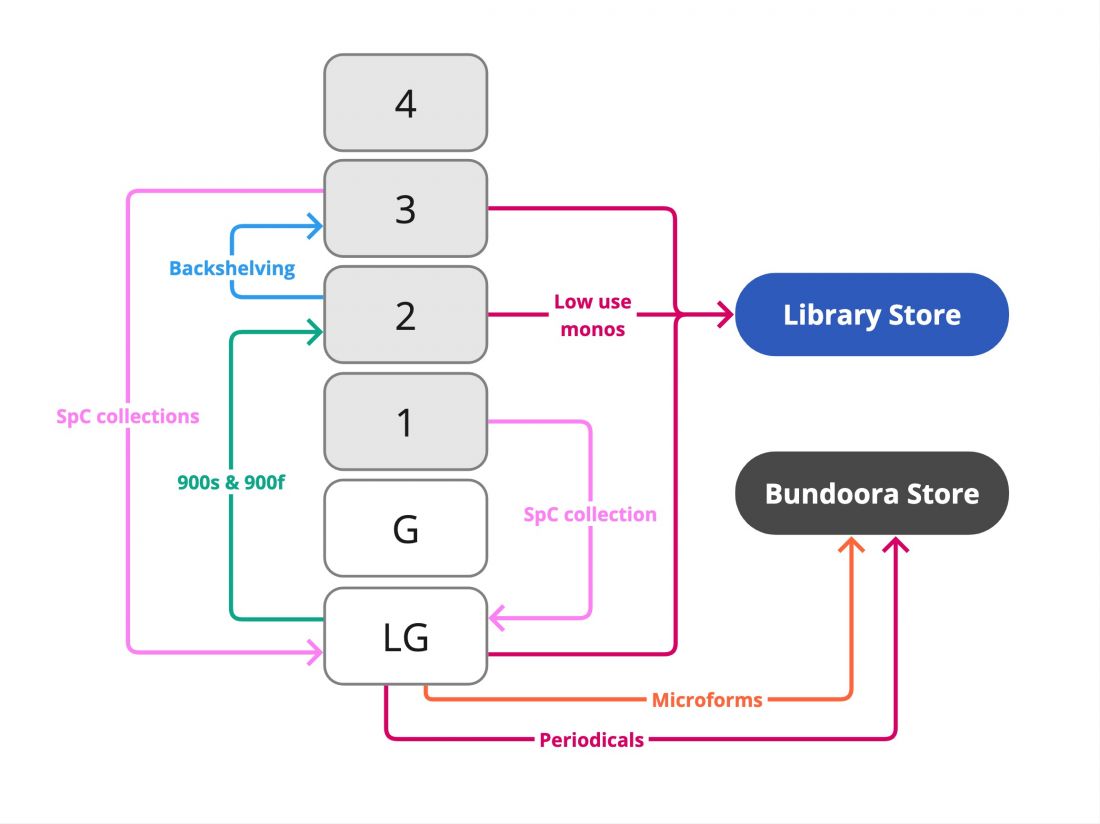
This process commenced in the 2024/2025 holiday period, and concluded in mid-July 2025. Locations of material moved offsite have been updated in the library catalogue and can be accessed via the library catalogue.
We are confident that teaching, learning and research needs can continue to be effectively met through forward planning, digitisation and the library’s comprehensive digital library catalogue.
Open Information Session
On Tuesday 3rd of December 2024, an Open Information Session was held to explain and discuss changes in access to collections. This session was open to the University community.
Construction
Construction for Stage 1 is expected to commence on 17 November 2025, with anticipated completion in December 2026. Delivery will be staged to ensure the Baillieu Library can remain open during construction. Stage 1 – Nov 2025 to Dec 2026: Lower Ground refurbishment to rehouse Special Collections; Stage 2 – in 2027, to be confirmed: Concurrent refurbishment of Level 1 and 3. These program dates are indicative. Any significant changes in the program will be communicated.
Yes. The Reading Room will remain open for research using archival collections during Stage 1 of construction, however please note that the Special Collections are temporarily unavailable during their move. The Reading Room will be temporarily relocated during Stage 2 of works. This will be communicated ahead of Stage 2 works commencing.
It is crucial that we protect the library’s Special Collections during their relocation to the refurbished Lower Ground. Special Collections will be stored safely within the Baillieu Library to prepare for their relocation, restricting their access from 15 June 2026, with gradual re-opening throughout Semester 1 2027. The ASC team is available to assist you in establishing the best alternative arrangement for your needs. Please contact Kathryn Hore, Associate Director, Archives and Special Collections to commence preparations.
There are still plenty of great study spaces within the Baillieu Library and on campus to suit a range of different study needs.
- Alternative informal study spaces can be found on all floors of the library (note: levels 1-3 are for quieter study).
- You may also wish to explore a range of other informal study spaces available on campus, including other libraries on the Parkville campus.
- If you’re looking for somewhere where you don’t need to worry about being quiet, good options are Baillieu Library (ground floor) and ERC Library (ground floor).
A disruption management plan is in place with controls to minimise disruption, including:
- A staged delivery, keeping as many spaces open as possible.
- Conducting excessively noisy or disruptive works outside the hours of 8.30 am-5.00 pm Monday to Friday, and 11:00 am-5:00 pm Saturdays, or during semester breaks.
- Keeping the main stairwell and lifts available for exclusive use by library users.
- Installing temporary timber hoarding around construction zones to limit dispersion of dust and noise.
Yes. The Mail Room will continue its operations in the Lower Ground during works.
If you wish to speak to a member of the University’s project team, please contact Phil Brady, Project Manager via email, or for more urgent matters please call 0432 549 396.
Yes. Emergency exits will not be impacted by infrastructure works and will remain operational throughout construction.
The main stairwell and lifts will be available for exclusive use by library users. A detailed plan has been agreed with our construction partners to minimise disruption, including access to one staircase to enter/exit the library.
The podcasting studio will be decommissioned in early 2026 and will be replaced with upgraded rooms as part of the redevelopment.
FAQs - Collections Moved Offsite
Baillieu Library print Periodicals / Journals, Microfiche and Microfilm, and selected low use items across the Library general bookshelves moved offsite during December 2024 and July 2025. All items in offsite storage can be requested via the Library catalogue.
No, there is no detailed list that can be shared – however all item locations have been updated in the Library catalogue.
No. The collections will remain in the Baillieu Library in current storage areas until the Lower Ground is redeveloped.
Collection moves have changed the location of some subject areas. Level 3 now contains Dewey run 000-699. Level 2 now contains Dewey run 700-999. Lower Ground floor no longer contains any of the general collections. Signage is in place to assist staff and students with the new location of material.
The Library needs to offer both collections and seating, or it will not function in the best way for our students and staff. While demand for digital resources is increasing exponentially, the University continues to acquire print materials. This requires a regular review of shelved collections to relocate low use material from all University libraries to offsite storage. Lockdowns impacted this regular review process resulting in overcrowding of shelves, which needs to be rectified.
Items from the general collections were moved in order to create space for items that were previously housed in the Lower Ground. When the space required was determined, we calculated the amount of books for relocation to offsite storage, in order to create space on Baillieu Library shelves. We identified from our catalogue database sufficient items that have not been borrowed since a set date e.g. 2014, in order to fit the materials into the shelf space available.
Currently, only print periodicals and Microfiche and Microfilm located in the Baillieu Library will be moved to offsite storage as entire collections.
For the Baillieu Library general collections, low use items will be selected from across the entire Dewey range to be moved to offsite. This will create sufficient space to relocate to general collections in the lower ground to Level 2.
No, print items are added to all our branch libraries each year should this be the preferred format for teaching or research purposes, or when libraries are only offered a print purchase by publishers.
The Faculty of Arts senior leadership team were advised of the upcoming collection review with opportunity to provide advice on how we could gather feedback from the University community. Subsequently the University community were given the opportunity to provide feedback in June/July 2024 through an online survey.
Optimum storage facilities for all collections is critical. As Microfiche and Microfilm materials can contribute to erosion of some items in the Special Collections, storing them in an offsite location with improved storage conditions preserves both collections.
Most of our library branches are already stretched to meet the needs of their own collections and informal study seating. A number of branch libraries have moved low use materials to off-site storage for many years now. The University library catalogue retrieval system is used to meet the information needs of our academic community.
FAQs - Accessing Collections in Offsite Storage
Find the record for the item you need in the Library Catalogue. Access can be requested using your staff or student number. Items will be retrieved within 2 business days for Parkville campuses but may take longer for other delivery points.
The University library catalogue is designed to enable search across all collections, including those that may be out on loan, in offsite stores, digitised or in other branches.
The library catalogue now offers an improved experience to physically browsing shelves, allowing online discovery of related collections. Once an item is found in the catalogue, the item’s record will offer clickable subject links to all similar catalogued items on that subject across all ten University libraries. Alternatively, call numbers can be searched to browse a list of items which would have been housed together on a library shelf.
If you only wish to browse store items you can limit your search to the Offsite Storage scope.
Low use items in-campus collections across all disciplines are regularly identified and moved to offsite storage. Offsite storage has been a collection management strategy for many years, complementing on-campus collections held in University libraries. There are three offsite warehouses that currently hold over 45km of academic scholarly materials in a range of physical formats. Requests to use or borrow these items can be made via the Library catalogue. Items are retrieved by library staff and are available to you within two business days. You can use the retrieved items either in a library or borrow them, depending upon usage restrictions.
In addition to on-campus and offsite collections, library users can also access:
- Digitised collections
- Reciprocal borrowing agreements with other libraries which allow our academic community to borrow from other collections – See https://library.unimelb.edu.au/borrowing/borrowing_at_other_unis
- Inter-library loans for all current staff and students. We can order items from other libraries across the world for your study – See https://library.unimelb.edu.au/borrowing/borrowing_at_other_unis/interlibrary-loans
Walk-up access to the Baillieu Library general collections may be restricted during the short-term project to identify items for relocation to relocation to offsite storage and relocating basement items to Level 2. The following steps will be used to reduce the impact on library users:
- Providing advance notice about collection moves
- Identifying ways to continue offering access to collections during the relocation process
- Identifying peak usage periods of the library to minimise disruption to access
- Monitoring building noise
FAQs - Accessing Baillieu Special Collections
Stage 1 of construction commenced 17 November 2025, with expected completion in December 2026. Stage 2 is pending funding to be confirmed in the 2027 Capital Plan. This timing is indicative and may change due to dependencies and outcomes of the construction tender process.
Yes, during stage 1 the Reading Room will remain open during the relocation for access to University of Melbourne Archives material, though it will be temporarily in a new location .
During stage 2, there will be a short period of less than a month in which the Reading Room operation itself needs to move. This will be after the collection moves are complete, and the Level 1 spaces are rebuilt, and should not be a major disruption. For any research critically required during this brief time, we will work with readers to make other arrangements.
Yes. Ensuring the safety of Special Collections has underscored all infrastructure decisions made to date. This includes thorough risk mitigation:
- A dedicated room with gas suppression fire protection for the highest value Special Collection items.
- Other areas where Special Collections may be housed will feature pre-action sprinkler system. This system ensures there is no water stored in the sprinkler pipes, reducing risk of accidental triggering of sprinklers.
- Civil engineers have completed a review of external areas and upgrade works will be completed to reduce risk of any flooding or water ingress, including from Professor’s Walk and the loading bay area.
- Hydraulic plans include improved drainage external to the building to reduce risk of water ingress during significant rain events.
- The Level 3 and Level 4 roof will be remediated to stop leaks.
- Works to the façade will also ensure safety and security of the collections on Lower Ground.
- A new mechanical system will ensure best practice temperature and humidity control.
- Toilets on the Ground Floor are undergoing a review to minimise risk of leaks and floods.
Unfortunately, we will need to temporarily restrict, and in some cases, close access to the Special Collections while they are being relocated. This includes the preparation period prior to moving the collections as they require handling with particular care due to their age, fragility and rarity, as well as the relocation itself, and re-establishing the collections in their new storage area.
Access to the Special Collections will likely be impacted in Semester 2 2026 and Semester 1 2027.
We are now seeking to work with academics and faculties, prior to this period of disruption, to understand how this will impact teaching and research, and what alternatives we can provide during this temporarily collection access restriction.
In particular, we would like to identify where we can:
- Digitise in advance and provide digital surrogates
- Provide alternatives from other collections, such the University of Melbourne Archives
- Assist in developing collection-agnostic content
- Provide expertise from our Curators to talk about the collections, while the collections themselves are inaccessible
If none of the alternative options provided are possible for your classes, and the temporary collection closure will significantly impact the student experience, with risks to learning outcomes and assessments, please contact Kathryn Hore, Associate Director of Archives and Special Collections, to discuss: kathryn.hore@unimelb.edu.au
The Baillieu Special Collections comprise of the Rare Books, Rare Music, Prints & Drawings, Rare Maps and Rare East Asian collections, which date from the 8th century through to the present day. They represent collections of high value, rarity, fragility and significance, with objects that are often unique and irreplaceable.
The Baillieu Library has housed the University’s Special Collections since its opening in 1959, however the storage for them has not been updated since that time. As these collections contain objects that are highly valuable and highly fragile, they need to be handled in particular ways to ensure they are not damaged or destroyed, and housed in storage conditions that ensure their long-term preservation.
Importantly, professional removalists with experience and skills in handling books and Special Collections have been engaged to pack and move our collections next year.