Latest Updates
Latest estate news and archive of quarterly development updates.
Our campuses and precincts bring the University’s purpose to life, benefiting society through the transformative impact of education and research, focusing investment where it delivers the greatest impact for students, staff and research.
Our estate vision translates Strategy 2030 into a clear, long-term direction for our places, supporting exceptional education and transformational research, and enabling a resilient University that serves and connects Country, people and community.
We manage the University’s estate with a strong focus on stewardship, sustainability and long-term value.
Vibrant, inclusive and high-quality learning environments that support student success and belonging.
High-performing, adaptable research environments and precinct connections that enable collaboration, translation and impact.
A safe, sustainable and accessible estate that strengthens institutional resilience and serves and connects Country, people and community.
Our Estate is a critical enabler of Strategy 2030. We are delivering a program of projects and renewal across our campuses, focused on improving student and staff experience, enabling research, and maintaining critical infrastructure.
Our Estate is shaped by a long-term direction, translated into action through planning, prioritisation and delivery.
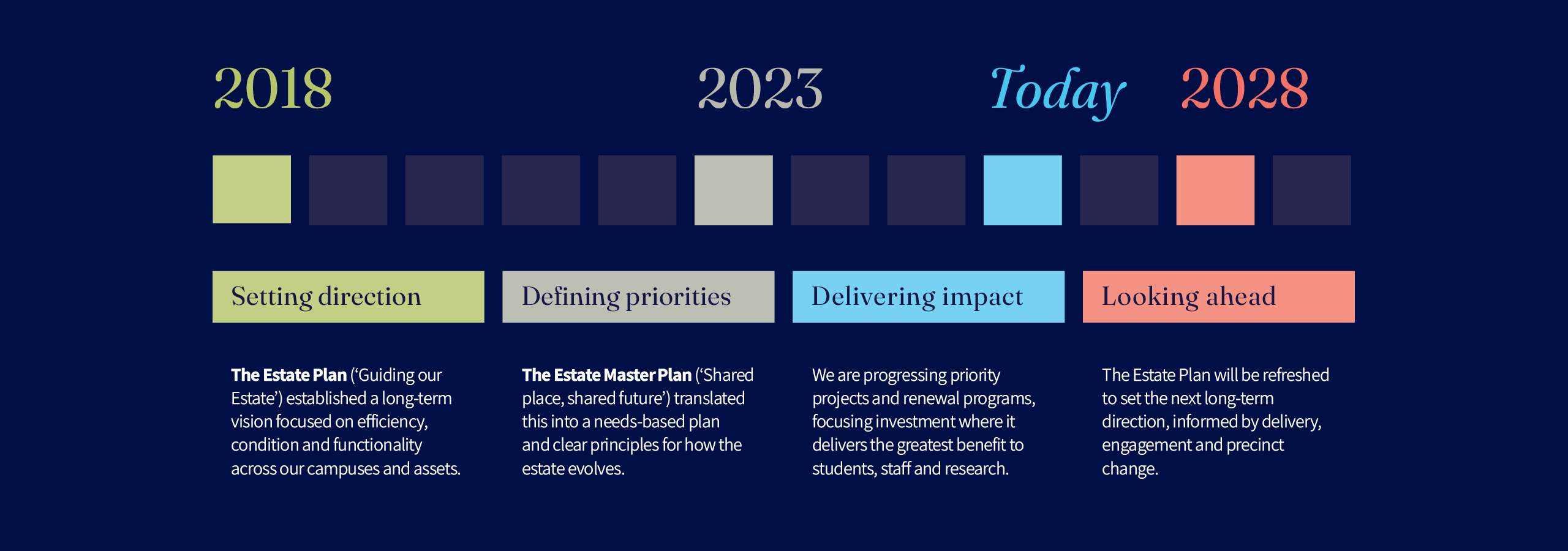
The Estate Plan (2018) targeted renewal of buildings and infrastructure to improve condition, accessibility and performance.
Find out moreReducing emissions, improving efficiency and designing for a changing climate.
Download the PlanThe Estate Master Plan (2023) was created with government and partners to strengthen our campus ecosystems.
Download the Master PlanThe University’s Estate Master Plan was launched in 2023. It outlines over 70 priority estate needs for the University and describes a vision for a campus experience that fosters diversity, innovation, and a global mindset.
The University of Melbourne has a long-term Estate Plan to ensure its campuses, buildings and infrastructure continue to support world-class teaching, learning and research. Completed in 2018, this plan brings together how the University plans, manages and develops its physical spaces over time, with a focus on improving efficiency, maintaining building quality and ensuring spaces are fit for purpose. In 2023, this was further developed through the Estate Master Plan, supporting the delivery of the Estate Plan by outlining how the University will respond to changing institutional needs and invest in its campuses into the future.
The University’s estate vision plays a key role in delivering the priorities set out in Strategy 2030. High-quality campuses, facilities and infrastructure support excellence in teaching, learning and research, while enabling deeper engagement with communities and partners. The Estate Master Plan, launched in 2023, aligns with the University’s strategic direction by improving the campus experience, supporting new ways of learning and research, and creating spaces that foster collaboration, innovation and inclusion. Through careful planning and investment, the estate will help deliver long-term value for students, staff and the broader community.
The University’s buildings, infrastructure and equipment are central to the experience of students and staff. High-quality learning spaces, modern research facilities and well-connected campuses support academic excellence and innovation. Ongoing investment ensures these spaces remain contemporary, accessible and capable of supporting evolving approaches to teaching, learning and research.
Since 2023, the University has delivered a range of projects to support education, research and student experience.
This includes new and upgraded teaching spaces such as the University’s first integrated medial production studios, improved dance and performance facilities, an animation studio and refurbished lecture theatres and learning environments. New adaptable teaching spaces and informal study areas have also been introduced to support flexible and student-centred learning.
Research facilities have been expanded through projects such as new laboratory spaces, co-located research centres and major developments like the Aikenhead Centre for Medical Discovery, which brings together researchers and industry to accelerate innovation.
Student-focused improvements include new accommodation, expanded Indigenous facilities, and more accessible and affordable campus amenities such as food services and shared spaces.
Delivering on Education needs
Delivering on Research needs
Delivering onStudent needs
The University is committed to protecting and celebrating its heritage while ensuring our campuses continue to evolve to meet the needs of a modern, globally connected university. More than 55 per cent of the University’s estate is heritage protected and our approach is guided by the Burra Charter and complies with the Heritage Act 2017 and other relevant planning controls.
Where possible, we prioritise renewal and adaptive reuse, upgrading heritage buildings to meet contemporary teaching, research, accessibility and environmental standards while retaining defining character and assessed heritage significance.
Across the estate, we seek to preserve the carbon embodied in existing buildings by pursuing refurbishment and retrofit wherever that approach can deliver the required outcomes.
In some cases, new development is required to deliver the scale, performance and functionality needed. When this occurs, new buildings are designed to complement the campus’s heritage, incorporated assessed values and contribute to a cohesive, high-quality environment.
Sustainability is central to our mission and embedded across our teaching, research, and the way we operate. As a leading global university, we have a responsibility to model sustainable practices throughout our institution and the communities we serve.
The Sustainability Plan 2030 focuses on strong climate action, sustainable campus operations, embedding sustainability in research and education, and partnering with our community to deliver measurable environmental and social impact. The Plan is currently being refreshed to ensure it reflects global best practice and it supports us to deliver on our ambitions, as well as addressing any area of underperformance. Our focus will continue to be on delivering meaningful social and environmental impact, guided by Strategy 2030. The annual Sustainability Report shows our progress on targets.